


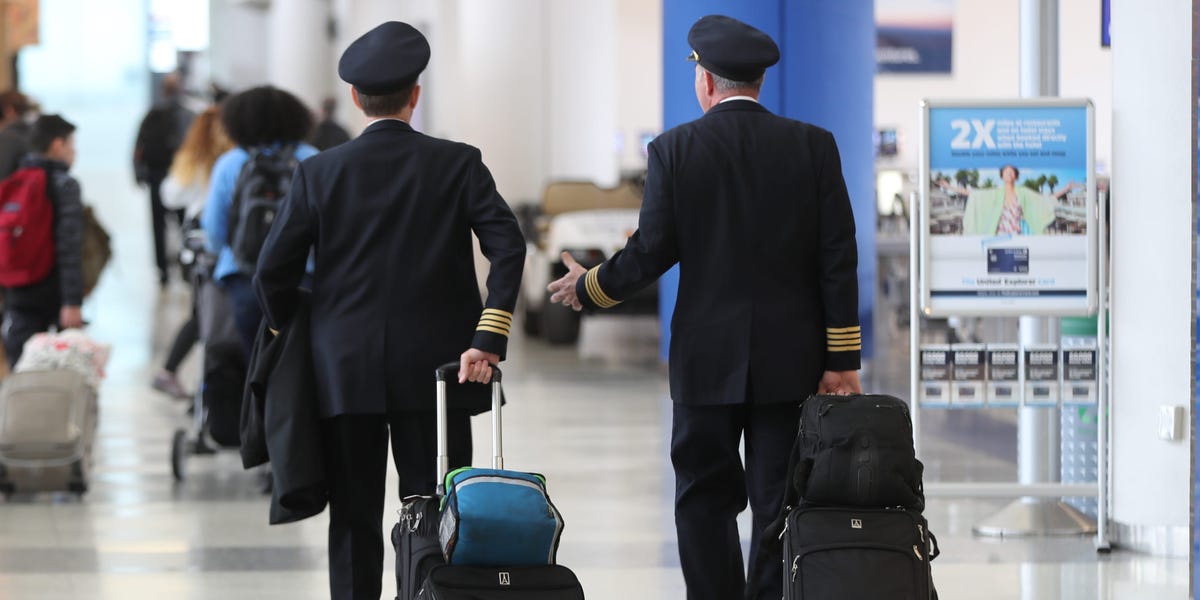
A Canadian man got hundreds of free flights on multiple US carriers by allegedly posing as an off-duty airline pilot or flight attendant.
Prosecutors say he never paid for the tickets, but experts warn the real concern isn’t the free rides — it’s the flawed security measures he exposed.
A federal indictment in Hawaii says 33-year-old Dallas Pokornik was a flight attendant at a Toronto-based airline from 2017 to 2019. From 2020 to 2024, he allegedly used a fake identification badge based on his former company to secure free tickets on three US airlines headquartered in Honolulu, Chicago, and Fort Worth.
Most airlines allow their crew and other staff to fly for free or at a highly discounted rate if a seat is available.
Court documents also state that Pokornik sometimes requested access to the cockpit jump seat — a spare seat in the cockpit reserved for industry professionals like regulators or off-duty pilots. They do not clarify whether Pokornik, who is not a pilot, ever gained access to a flight deck.
Pokornik’s actions, as alleged by the Justice Department, suggest several guardrails — including airline ID verification, airport credential checks, and crew-only boarding procedures — may have been bypassed across multiple carriers.
“Everybody loves to hate the airlines, and it’s fun to think they got ripped off,” aviation analyst Henry Harteveldt told Business Insider. “But the point is that this man’s actions are extremely serious. A potential terrorist could see this and think, ‘Look, there’s a loophole.'”
The case gained national attention after Pokornik’s extradition from Panama in January. He is charged with two counts of wire fraud, to which he pleaded not guilty, and faces up to 20 years in prison and a $250,000 fine if convicted.
The case has been described online as a real-life “Catch Me If You Can,” a 2002 movie where Leonardo DiCaprio plays a pilot impersonator cashing in fraudulent checks. That story was set in the 1960s, while Pokornik’s alleged exploits occurred in a post-9/11 aviation environment with far more security.
Harteveldt said this case points to weaknesses in airline verification systems that rely heavily on mutual trust between carriers to ensure that only active, vetted crew members are granted credentials.
Airport personnel would have had to accept Pokornik’s fake credentials multiple times without properly checking databases, Harteveldt added, and it remains unclear how he consistently obtained boarding documents to pass through security.
Retired airline pilot Mark Stephens told Business Insider that the alleged request to sit in the jump seat is particularly concerning, given that the flight deck is one of the aviation industry’s most tightly controlled spaces.
“If another airline’s crewmember wanted to jump seat in my cockpit, they had to provide me their pilot’s license, a company badge, and a valid medical,” Stephens said. “He would have had to come up with all of those; that’s why this is so baffling to me.”
The potential consequences of system slips were highlighted in October 2023, when an off-duty Alaska Airlines pilot in the cockpit jump seat of a Horizon Air flight attempted to shut down the engines mid-flight during a mental health crisis. The crew restrained him and landed safely.
It’s unclear which airlines Pokornik allegedly defrauded, but the US cities named by prosecutors correspond to Hawaiian Airlines, United Airlines, and American Airlines. Porter Airlines is headquartered in Toronto.
United declined to comment. The other airlines, as well as Pokornik’s attorneys and the US Attorney’s Office, did not immediately respond to requests for comment.
Multiple layers of airline and airport security were breached
Stephens said it’s difficult to determine how Pokornik got from the curb to the gate with just a fake airline badge since airline staff travel is a credentialed benefit that typically requires a verified employee profile, a valid employee number, and confirmation that the person is actively employed.
Airports have a security screening line reserved for eligible pilots and flight attendants, called the Known Crew Member (KCM) lane. The process is generally more relaxed than for standard passenger screening because crew members should have already undergone extensive background checks, Harteveldt said.
KCM is limited to enrolled US airlines and is not available to foreign carriers, and prosecutors say Pokornik was impersonating a crew member at a Canadian airline.
Theoretically, he could have used fake credentials at the pre-security check-in counter to obtain legitimate boarding passes and clear the regular passenger checkpoint. Airline employees flying on standby often receive temporary documents that allow them to clear security before a seat is assigned.
Possible explanations include a computer error, a stolen identity belonging to someone active at the airline, or help from someone on the inside.
At the gate, Stephens said, Pokornik would have needed an agent to verify his credentials before boarding if he wanted a jump seat. This usually involves the gate agent confirming eligibility in the airline’s system.
Stephens added that it’s possible the booking system didn’t contain Pokornik’s photo, since his badge was from a different airline: “A universal positive ID system that matches the badge presented at the time of boarding to a verified employee profile would be one solution,” he said.
Even if Pokornik never made it into a cockpit, the scale of the incident is alarming, Harteveldt said.
Prosecutors say Pokornik took hundreds of flights across three airlines over several years — suggesting he wasn’t exploiting a single weak system, but rather repeatedly navigating independent airline and airport security processes without being stopped.
“Airlines should be grateful that these weaknesses were exposed in a relatively benign manner, but should be alarmed that these weaknesses exist at all,” Harteveldt said. “Safety agencies should ask [Pokornik] how he did this; his experience could help prevent this type of breach from happening again.”
Read the full article here