




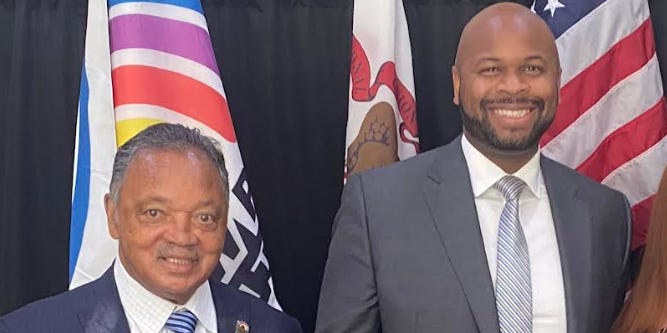
Rev. Jesse Jackson Sr. took a chance on me as a 19-year-old college student.
At that age, as an intern in 2009, I should’ve been pouring coffee, maybe making copies. Instead, he put me to work on college affordability policy, youth violence prevention, and immigration reform at his Rainbow PUSH (People United to Serve Humanity) Coalition on the South Side of Chicago.
That was nearly two decades ago. This week, he passed away.
A few weeks ago, I sat with him in the hospital. He was extremely present even as Progressive Supranuclear Palsy disorder had taken his voice — the same instrument that had formed seemingly impossible coalitions and made the moral case for justice in language that brought people together instead of tearing them apart.
I considered Rev. Jackson a close mentor
I met him in 2009 at a press conference he held to announce his intention to negotiate the release of journalist Roxana Saberi from an Iranian prison.
Saberi was an alum of Northwestern University, where I was a student. Several classmates and I had staged a rally to call attention to her issue, and Rev. Jackson had invited us to join him at his press conference in Chicago.
When it ended and everyone packed up to leave, I made a split-second decision.
I grabbed him by the shoulder — strongly enough that his security detail sprang into action — and asked if I could volunteer for his Reduce-the-Rate initiative on college affordability. It was an issue that deeply resonated with me, as I’d borrowed a crippling amount to attend Northwestern. He said yes.
That moment changed everything. Less than a month later, I became the campaign’s manager, working part-time during school. I handled policy research and community interface and accompanied Rev. Jackson to meetings and events. I spent time with him every week and at times even did my homework at his house.
He became a mentor, coaching me and looking out for me not only professionally, but personally. I left the role in 2011, but over the years, we stayed close.
From Rev. Jackson, I learned three lessons about leadership that have shaped everything I’ve done since.
Lesson 1: Lean into hard moments, not out.
Rev. Jackson had a pattern: When things got difficult, he moved closer to the problem, not away from it.
He negotiated the release of over 200 hostages across Syria, Cuba, Iraq, and Serbia. He flew into war zones and sat across the table from dictators. He showed up to Texaco’s headquarters during their discrimination scandal. He walked into corporate boardrooms where he wasn’t welcome.
Many leaders I know do the opposite. When crisis hits, they create distance — delegate to lawyers, let the public relations team handle it, wait for it to blow over.
Rev. Jackson taught me that the moments when you want to step back are precisely when you need to step forward. Your measure as a leader is taken in the hardest moments, not the easy ones.
Lesson 2: Never stop investing in people.
Rev. Jackson had no reason to believe in my abilities. But he understood that individuals have incredible capacity for growth — they just don’t start off optimally productive.
He put a 19-year-old on policy work that mattered, then put me on-air representing the campaign. That wasn’t reckless — it was intentional investment. He knew that by giving people opportunities, some would disappoint him over the years, but the ones who didn’t might surpass what he could’ve imagined.
I’ve carried that forward — looking for people others overlook and investing in their growth. Not everyone pans out. But the ones who do become extraordinary.
Real leadership isn’t about finding perfect people. It’s about developing the potential in imperfect ones.
Lesson 3: Conflict and conversation can coexist.
Rev. Jackson was simultaneously the agitator and the negotiator. The prophet and the pragmatist.
He showed up uninvited to shareholder meetings and organized boycotts, but also sat down with those same executives afterward to identify resolutions.
“Diamonds can’t be produced without pressure,” he once told me. This applies to individuals, organizations, and systems.
He understood that real change requires both confrontation and conversation. You can’t just be nice and hope things improve. But you also can’t only apply pressure and expect people to come around.
I watched him do this with the Wall Street Project, pressuring corporations like Texaco and Coca-Cola to commit billions to diversity initiatives. He made them uncomfortable with boycotts. Then he sat down with their leadership and helped build solutions.
Too many leaders think they have to choose to either be tough or be empathetic. Rev. Jackson taught me that’s a false choice; the best leaders do both.
The work continues
Rev. Jackson once told me the work of justice isn’t about being comfortable. It’s about being consistent. It’s about showing up when it’s hard, especially when staying silent would be easier.
He showed up. Consistently. The work he did — building coalitions across impossible divides, making the moral case in language that united rather than divided — we need it now more than ever.
Last year, during one of my Saturday visits to Rainbow PUSH, I brought the manuscript for my book “Faster. Messier. Tougher: Crisis Communications Strategies in an Era of Populism, AI, and Distrust.” He saw how I was continuing on the work and agreed to put his name behind it.
Last week, when I held the first copy from the printer and saw the quote from him on the front cover, it was so moving. That he could support me one last time means the world to me.
I grabbed his shoulder at 19 because I didn’t want to let the moment pass. He taught me to lean into hard moments, develop people others overlook, and hold the tension between conflict and conversation.
That work doesn’t end with him. It’s up to us to pick it up.
Bradley Akubuiro is a partner at Bully Pulpit International, where he advises corporate leaders like Levi Strauss and the NFL on high-visibility reputation and diversity and inclusion matters.
Read the full article here