

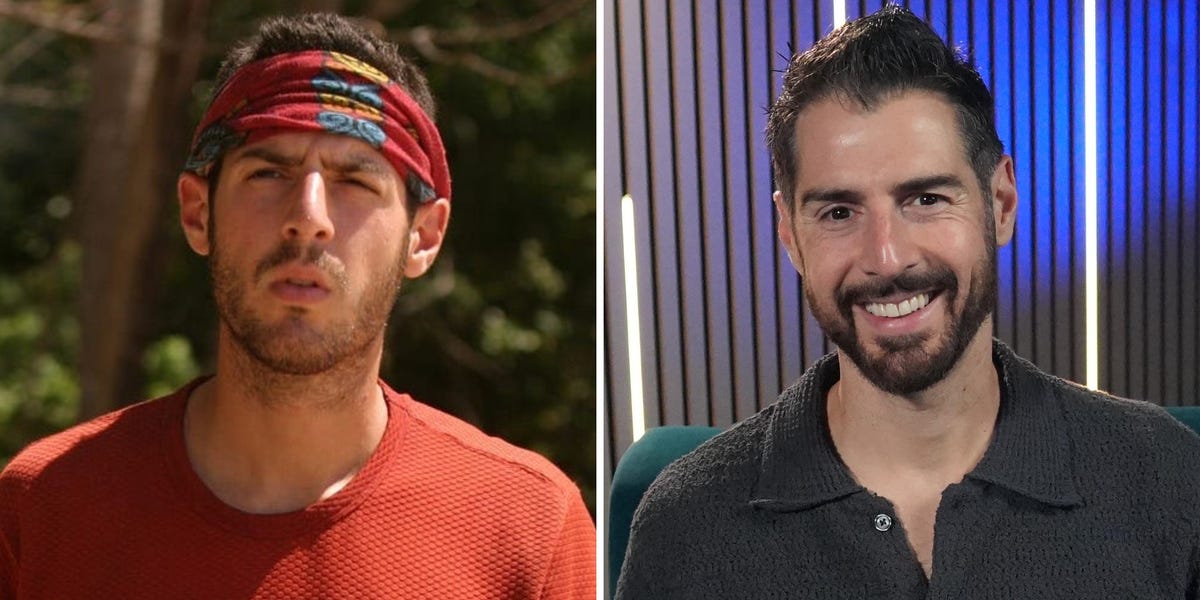
This as-told-to essay is based on a conversation with Rob Cesternino, 47, who appeared on “Survivor: The Amazon” in 2003 and “Survivor: All Stars” in 2004. He went on to launch his podcast, “Rob Has a Podcast,” in 2010 and has since expanded it into a network with dozens of shows and hosts. His book,”The Tribe and I Have Spoken: The Definitive (Unofficial) Lore and Legacy from the Game’s Smartest Surviving Loser,” is in stores now. The conversation has been edited for length and clarity.
I was a broke college student when “Survivor” premiered in the summer of 2000, and I was obsessed. I thought, “I should be one of the people on these shows one day.”
A couple of years later, I thought maybe a better path for me would be to go on “Big Brother,” because I wouldn’t have to live outside on that show.
I got very close to being on “Big Brother” but didn’t get selected. But the casting people remembered me, and they asked me to be on “Survivor” season six, which was filmed in 2002.
I never really thought, “Okay, I’m going to go on reality TV and be famous.”
Every time Samantha publishes a story, you’ll get an alert straight to your inbox!
Stay connected to Samantha and get more of their work as it publishes.
I had gone to the State University of New York at Oswego and studied broadcasting. I always wanted to work in media, but at the time, I was working at an insurance brokerage on Long Island, which was run by a family friend.
I knew what I wanted to do, but I didn’t know where to start. So I didn’t have too many other better ideas other than “I’ll just get on reality TV, and then I will meet people who work in television.”
I did well on my first ‘Survivor’ season and was asked back, but filming two seasons in a row was tough
Right after I filmed the first season, they announced that there was going to be “Survivor: All Stars.” So very quickly, I went from my first season of “Survivor” to “All Stars” a couple months later.
What I did not see coming was that “Survivor: All Stars” did not go great for me. Once that was over, I felt a little bit thrown away. I felt like, “Well, now what am I going to do?”
I was struggling. I thought, “Am I just going to go back to the insurance office?”
I was hungry to find some work that I actually wanted to do. I had been approached by some producers who were working on a website out in California called the Fishbowl. The idea was that the reality TV industry builds these people up from nobody, and then they throw them in the garbage. But what if we could be recycled?
I started doing what they called an “internet radio show,” where we would do interviews with reality stars and upload them to a website. Eventually, I moved out to Los Angeles to work for them full-time. After I worked there for two years, the company went out of business.
It was the early days of YouTube, so then I started working in video production. I learned a lot, but after working at another company, they also lost their funding.
I started podcasting when I was laid off in 2010
In 2010, I was out of work and looking for production jobs in Los Angeles. I thought, “Maybe I could start podcasting and that could be something that could help me get my name out there.” At least when I go for these job interviews, then people will say, “At least he’s doing something.”
I started podcasting during “Survivor: Heroes vs. Villains.” It never turned into something where anybody was like, “Hey, we have to give this person a job.” But it became something where we had more and more people discovering the show.
In 2013, my first son, Dominic, was born. I had been doing the podcast and also trying to work at the same time, but it was very difficult to do everything.
By the end of 2013, I had been laid off again from another video production job. It felt like a real low point of, “Okay, now I’m a dad, I’m a husband, I have no job. What am I doing?” I’m also kind of unemployable because I have this other podcast that is consuming more and more of my time.
I reached the conclusion that it was riskier to not try to make the podcast work full-time. Otherwise, I’d be trying to get a job that I could have for a few months, only to get laid off again and be right back in the same spot. I wanted to get off of that merry-go-round.
I started doing the podcast full-time in 2014, and I’ve been doing it full-time since then.
I grew my business by building a loyal audience, then becoming an early adopter on Patreon
I was approached in 2013 by somebody who was a fan who worked at Patreon, who was trying to recruit me to use Patreon to crowdfund the podcast. I didn’t think people were going to pay for it, but I was desperate. So in 2014, I ended up becoming one of the very early adopters on Patreon.
I’ve been on Patreon now for 12 years. It’s been the heart and soul of the podcast in terms of bringing in the most engaged community members.
Before that, our listeners were siloed. Patreon was the point where all these people who were engaged lovers of “Survivor” met each other. Many became incredibly close and had all these relationships that formed out of that.
In the early days of “RHAP,” my wife was working full-time as a nurse. I remember I wanted to get to a milestone of making $5,000 a month from Patreon. I don’t remember at what point we hit that milestone, but at some point in the first year, we did.
I was overwhelmed by the amount of people who were reaching out to say, “I really love this thing that you’re doing, and I’m happy to make a contribution to keep this thing going.”
I think Patreon worked because it wasn’t something that I started doing and said, “Hey, here’s the Patreon link where you can go and join this new thing that I started and help me out.” I had already been four years into the podcast, so I had a really good track record with a lot of people. I had put out so much free content for years, and people did not want to see that type of content stop.
Being both the host and the CEO is hectic
So much has changed about “RHAP” over more than 15 years.
Since 2020 and the lockdowns, we’ve had exponential growth on our YouTube channel, where we do a simulcast of all of the video of the podcasts.
I think “RHAP” has had longevity because it has a very clear sensibility in terms of how we break down competition reality television: We’re there to talk about the game, but we’re also there to have fun. We also try to make it a town square for reality television, where not just the fans — but also the players and the alumni of these shows — can come together and be a part of the conversation.
It’s still a challenge for me to wear two main hats, where I am the on-camera face of “Rob Has a Podcast,” but then I also am the founder and CEO of the RHAP Network. I would love to eventually have more people behind the scenes helping me, so I could focus more on doing the thing that I think I am truly good at, which is being on the podcast.
I never want to stop podcasting, and I’d go back on reality TV, too
It’s hard to imagine myself ever stopping doing podcasts. I have so much fun, and I feel like I am only having more fun as this goes on. I love getting to interview people and talking to reality stars.
I also loved getting to go back and play on reality TV. While my time on “The Traitors” was short, I was happy that people felt like, “Has he still got it?” It was really fun, so I’d be very open to participating in future reality TV shows.
I also appreciated that Peacock let me podcast about the whole season while I was on it — it was fun to switch gears from being a player to being a commentator.
I would love to eventually find other ways to use some of this knowledge that I’ve gained about all of these reality shows. The 25th anniversary of “Survivor” seemed like a great point to be able to take some of the “Survivor” knowledge that I’ve gained over my life covering this show and try to put it all in one place in a book.
I’d also love to find more ways to play games with the pool of reality TV stars that we’ve met over the years. I think that’s something that could be a really, really fun next step for RHAP, to be able to come up with our own games to play.
I think “Survivor” is in a very healthy place, especially after Season 50. But if anything ever happened to “Survivor,” I hope that there will always be competition reality shows for us to talk about.
There’s something about reality TV that really does speak to that idea that we’re all looking for our own tribe of people.
Read the full article here