






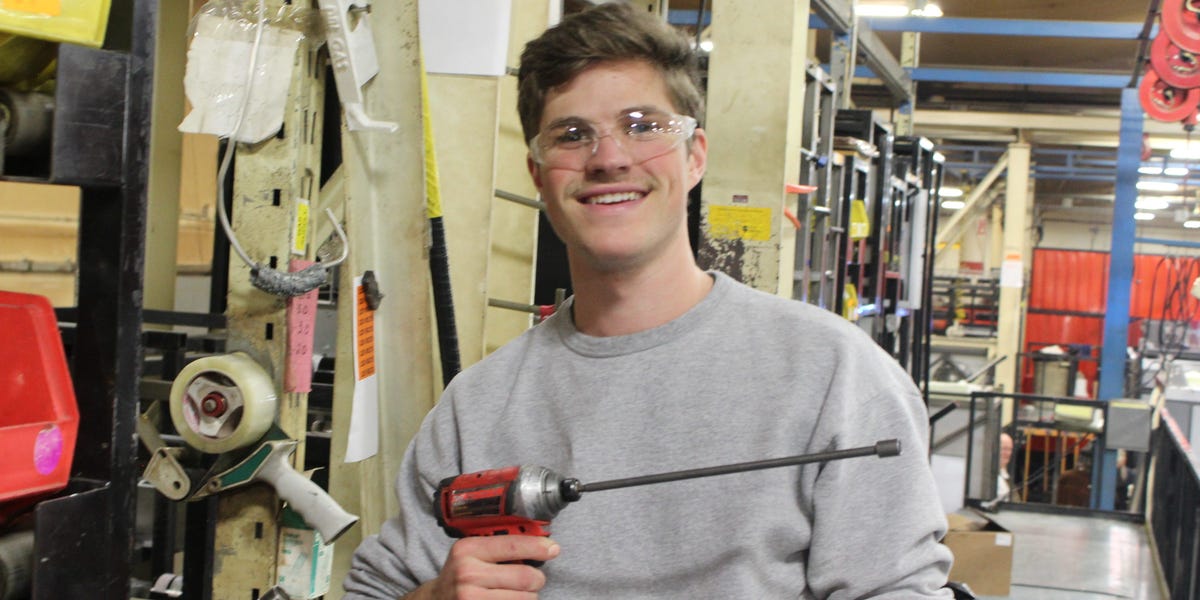
This as-told-to essay is based on a conversation with Justin Flint, 27, a software engineer at an oven manufacturing factory near Seattle, Washington. His employment and progression has been verified by Business Insider. This piece has been edited for length and clarity.
The first full-time job I could get after I dropped out of college in 2019 was in a factory building ovens, and it was miserable.
Inside the ovens, I’d be drenched in sweat and my safety glasses would fog up. I’d step out, wipe them off with my shirt, and get back to work, because that was my only option.
It was horrible transitioning from taking mechanical engineering classes at college to working in a factory in the early hours of the morning. But one thing I’ve learned over the years is the importance of patience.
Sometimes you need to stick at something long enough for opportunities to materialize. When they do, you can showcase your skills and move up in the world. That’s what happened to me, and now I’m a software engineer at the same company.
I had an early interest in inventing things
I fell in love with inventing things when I was a kid, and started 3D printing things as a teenager. One of my first inventions was a lid that stopped your knuckles from getting dirty when scraping peanut butter out from the bottom of a jar.
In 2017, I transferred from a college to a community college to be closer to home and continued studying mechanical engineering, then dropped out in 2019 to heal from a traumatic situation. I needed a full-time job and got hired to work on the assembly line at a local factory.
The job put me in a dark place. You’d show up before your 5 a.m. shift in steel-toe boots, wait in line to clock in, and then walk to your section of the assembly line.
I remember thinking that my career had crumbled. I was working in a factory, I still wanted to be an engineer, and I knew I could do more.
I was too slow at my job — so I 3D printed a fix that got me noticed
Twice a day, an engineer would oversee my work: using gauges to set sheet-metal shutters in the ovens. I was taking longer than management wanted, so the engineer asked me if I could find a way to do it faster or more efficiently.
One day, in May 2019, I wrote the dimensions of the gauges for each shutter on a sticky note. At home, I designed a fixture that would speed up my work by letting me set two shutters at once. I 3D printed it at home before my next shift, and took it in to show the engineer.
About a week later, the engineer’s boss came to the assembly line to ask if I had any experience with coding 3D printers, and I told him I had a tiny bit. A couple of weeks after that, I was asked to join the engineers for a brainstorm after work, which felt like a huge compliment.
In September, a position opened up for an engineering technician who would work on 3D designing sheet-metal parts for the ovens and printing inserts that would be used for oven handles. After applying and not hearing for a couple of months, I was thrilled to be selected for the job in December, which started in February 2020.
I was intimidated at first, but proud that I’d moved up from the assembly line.
I was missing coding from my skillset
About six months into the job, my manager asked me if I’d be willing to return to school if the company paid for it. It was a very easy “yes,” but it was hard to make it work. Five days a week, I drove for 40 minutes straight from work to school, took an hour-long class, and then drove back home.
It felt great to be back at school, learning C++, a programming language used for building software, and discovering how coding could open the door to developing things like apps. I realized coding was a missing component of my skillset.
But I was starting to feel burned out, so I decided to leave the oven factory in May 2022 to make more time for my studies.
In March 2023, I got my associate degree in engineering, computer science, and physics after studying full-time for about nine months. It was great to finally have something to show for all my years of hard work. It also gave me a safety net, a qualification that would prevent me from returning to the assembly line.
When I finished college I needed another full-time job. The only one I could find was at a printing factory as a technician, loading large printers with paper and performing maintenance on them. Back to working in factories, I felt like a failure.
If I ever completed printing jobs early, I would go on my phone and listen to podcasts or watch YouTube tutorials on coding. I fell in love with programming.
In June 2023, the oven factory reached out and offered me a software developer position. When I took the job, it felt like being back home. I’ll always appreciate them taking a bet on me.
It was a place where I’d originally not enjoyed working, because I saw it only for my job on the assembly line. But I felt like I was where I belonged when I returned as a software developer.
My advice: invent yourself out of a bad situation
I’m a software engineer II at the oven factory, which involves managing software projects, and my goal is to become a chief technology officer. The prospect of defining technological paths forward and designing tools that make people’s lives easier sounds so exciting. It would take me back to my roots: inventing things.
It’s what got me off the assembly line job, and if I hadn’t taken the initiative to build a fixture and show it to the engineering team, I’d never have been promoted.
Ultimately, I had to step on a few toes— politely — to show what I was capable of.
It’s easy to get stuck in a rut — trust me, I’ve been there — but I’ve learned that you can often invent your way out of a horrible situation. You simply need to search for opportunities to prove yourself.
If you study the work you do every day closely enough, you’ll find something to improve, and that improvement could be your golden ticket to promotion.
That’s what happened to me.
Read the full article here