





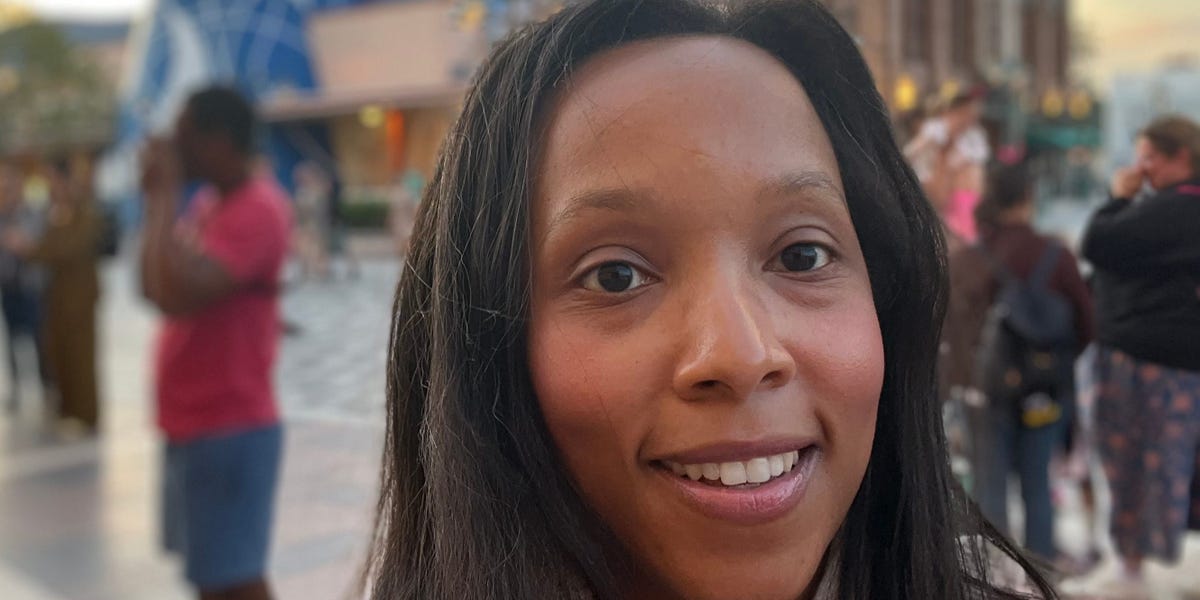
This as-told-to essay is based on a conversation with Candice Bryant, who worked as an internal communications manager at Google until last October, when she left to focus on independent consulting and building AI-related products. Before Google, Bryant spent about 16 years at the Central Intelligence Agency, where her last role was in communications. She’s in her early 40s and lives in the Washington, DC, area.
My whole career has really been a series of “Sure, I’ll try it” moments, and it all started with an opportunity I almost passed up.
More than two decades ago, while I was pursuing a political science degree at Towson University in Maryland, there was a career fair I almost didn’t attend because I didn’t have any professional clothes to wear. I grew up in Baltimore, and while I didn’t feel poor, I’ve since realized I was probably underprivileged.
My roommates convinced me to go to the career fair anyway. They told me to put on a coat and a nice pair of pants. It was winter, they reasoned, and nobody would know the difference.
At the event, I stopped by a table for the Central Intelligence Agency. I was looking for an internship, but the recruiter suggested I apply for a job. I applied for a full-time job as a political analyst and, after graduating in December 2004, started at the CIA the following month at age 21.
That chance encounter launched a career that would eventually take me from the CIA to Google and, later, entrepreneurship. Throughout my career, one of the biggest things I’ve learned is to always try to say yes when opportunities arise.
I spent about 16 years at the CIA
One of the biggest lessons I learned during my time at the CIA was how fragile the world can be — and how often decision-makers have to act quickly with incomplete information. My job as an analyst was to help bridge that gap.
In 2018, after more than a decade in various analyst roles, I was approached about moving into a communications role at the agency. I was drawn to the challenge of working in communications at an organization known for secrecy and to the opportunity to tell the story of the men and women who dedicate their lives to service, especially those who made the ultimate sacrifice.
Looking back, one of my biggest takeaways from the job was that my idea of a crisis or a bad day was very different from what I would later experience in the private sector.
Making the leap to Google
There was no push factor driving me out of the CIA. I believed in the agency’s mission and was continuing to advance my career there. But I believe it’s possible to have a mission-driven career in both the public and private sectors. When a former colleague reached out, and the opportunity to move to Google arose, I said yes.
I joined Google in September 2021 as an internal communications manager. Early on, much of my work was tied to the company’s response to the COVID-19 pandemic, including vaccine policy and return-to-office efforts.
After that work wound down, I was asked to move to Google’s Search organization, where my work focused on executive and internal communications. I joined the team during the early days of the generative AI boom, after ChatGPT launched and before Gemini was released.
I was thrilled about the move. I got to work with some brilliant engineers and help them translate their amazing work so anyone could understand it.
Read more about people who’ve found themselves at a corporate crossroads
Why I left Google
When I first started seeing Google’s AI tools come online, I was mesmerized by the technology. I remember seeing capabilities like NotebookLM’s ability to turn notes into a podcast and thinking, “This is going to change everything.”
Even as I saw the potential of these tools, I realized that almost no one in my life was using AI yet.
It dawned on me that a powerful technology nobody understands or uses isn’t going to transform anything. I came to believe the real gap wasn’t between Silicon Valley and policymakers — it was between Silicon Valley and everyone else. I increasingly felt I could have a bigger impact helping people understand AI from outside Google than from within it.
That’s why I ultimately decided to leave Google and pursue that mission independently.
Becoming an entrepreneur in my 40s
In October 2025, I left Google and began focusing full-time on my own business ventures. Leaving Google wasn’t scary because I already had the confidence to make the transition. I think working at places like the CIA or Google helped me become the type of person who could succeed not just at those organizations, but beyond them.
Today, my work includes advisory projects, angel investing, a weekly AI newsletter, and building AI-related products. I think of my new venture as a solar system with multiple pieces orbiting around the same mission: making technology more accessible to everyday people. I spent more than a decade at the CIA making complex things clear for presidents, and now I do it for everyone else.
Earlier this year, I launched an app called Cello that gives users daily prompts to help them explore practical uses of AI. I already have plans for a second app.
I’ve learned a lot so far. One thing is that building from inside an established brand is easier than building on your own, but what you build on your own is yours. Your successes and failures are yours alone.
For anyone interested in entrepreneurship, I’d recommend building your business in public rather than waiting until everything is perfect. If everything is perfect when you launch, you’ve probably waited too long to share about it.
I followed opportunities, not a set career path
I’ve become convinced that people shouldn’t feel pressured to follow a single career path or timeline. I joined the CIA in my 20s, Google in my 30s, and became an entrepreneur in my 40s.
For me, entrepreneurship feels like the right decision now, but it wouldn’t necessarily have been 10 years ago, while I was at the CIA.
I don’t think people should feel pressure to become entrepreneurs. There’s nothing wrong with working a corporate job, and even if you’re interested in entrepreneurship, it may only make sense during a certain phase of your life. Many successful entrepreneurs start their businesses in their 40s.
I’ve been building toward this moment for a while, perhaps starting around 2010, when my husband and I began investing in real estate and giving our future selves more freedom. The idea of entrepreneurship wasn’t new to me, but it’s taken a different form over time.
Just because something doesn’t make sense for you today doesn’t mean it won’t make sense later.
Do you have a story to share? Reach out to the reporter via email at jzinkula@businessinsider.com, or via Signal at jzinkula.29.
Read the full article here