




Grindr became one of the world’s best-known dating brands by helping men meet each other using their phones. Its marketing dollars, on the other hand, are increasingly being deployed in the real world.
Grindr CMO Tristan Pineiro told me that there are two pertinent — and digital — business reasons he’s betting big on IRL.
The photos and videos that people organically share when they’re enjoying an event can travel further on social media than the brand’s own posts. Then there’s a quirk of Grindr’s advertising business: Many brands are still wary of placing their ads inside a gay hook-up app.
“There is a lot of nervousness about it, with the whole rollback of DEI, a lot of brands have felt emboldened to say, ‘Oh well, we don’t need to bother anymore,'” Pineiro said. “There are brands we do work with that stuck with us, and there are others that have disappeared, or say the budget just isn’t there anymore.”
Getting into the IRL groove
Grindr joins brands like language-learning app Duolingo, home-improvement retailer Lowe’s, and AI company Anthropic, which have all been upping their experiential game in recent months. As big monoculture media moments dwindle and social feeds become ever more personalized, marketers are turning to events and pop-ups to build brand affinity and loyalty.
There’s another incentive to create experiences people want to talk about. A Brandwatch study published last year, analyzing more than 900 million online mentions, found that brand-owned accounts initiate fewer than 1% of posts about their own brands on X. For CMOs chasing social reach, increasingly, it pays to give people a reason to grab their phones.
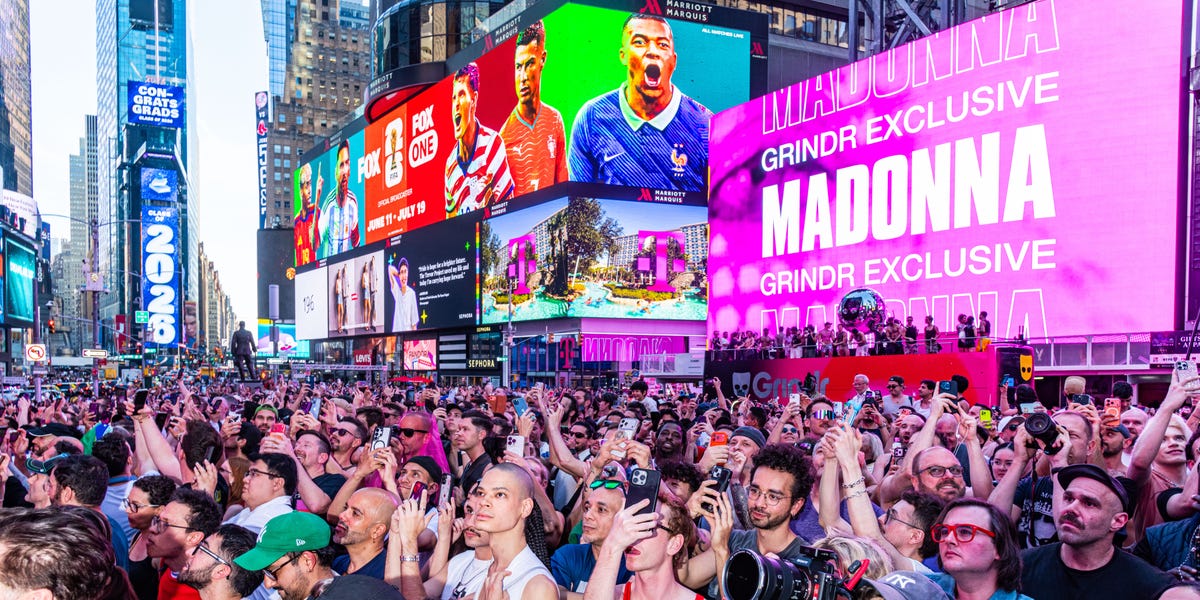
During Pride Month in June, Grindr announced a surprise Madonna concert in New York’s Times Square to promote her new album “Confessions II.” Grindr sent out a push notification within the app 30 minutes before the show, prompting 50,000 people to turn up, the company said, with many more viewing the livestream and clips on social media.
The Grindr-exclusive picture disc album vinyl was “the best-selling by far” of the “Confessions II” records, Pineiro said.
“I always say footfall isn’t enough,” Pineiro said. “It’s great to have people experience it in real life, but if they’re not taking a picture of it, and sharing it, and talking about it, and writing about it, then we haven’t really done our job.”
Want more Business Insider in your news feed?
Add BI in Google so our reporting is easier to find when you’re searching for what matters.
The broader four-month campaign included exclusive merch, an in-app takeover, content such as a celebrity quiz in Grindr’s in-app media hub, “Grindr Presents,” and a London launch party. (Grindr did take some heat on social media after users who opened the app were greeted with an audio message from Madonna saying, “Hi Grindr, it’s mother,” which some complained could unexpectedly “out” them in public. Grindr apologized and removed the message.)
Upcoming events include Grindr’s annual “Pleasure Ball” Halloween party, which returns to New York City on October 22 with a “Future Lovers” theme.
The company is also taking a branded Grindr bus on tour around Europe, offering merch giveaways, a profile-pic photo booth, and entertainment from DJs and drag queens. This week, it’s stopping at the Brava Madrid festival in Spain.
IRL events open up partnership opportunities for brands that are nervous about advertising in the Grindr app, particularly for CMOs with content-adjacency concerns top of mind.
“We can get some of their brand glow, they can get our reach and a partnership with the community,” Pineiro said.
Grindr has had an ad business since the launch of its free app in 2009, and has long pitched marketers on its global audience of millions of predominantly affluent, tech-savvy men. Grindr generated $73.6 million in “indirect revenue,” primarily from advertising, in 2025, up 37% from the prior year, attributing the increase to programmatic ads and international growth.
Nathan Feather, an internet analyst at Morgan Stanley, said that Grindr has around 60% global brand awareness despite historically spending “almost nothing” on marketing. But high brand awareness doesn’t inherently translate to brand love.
Feather said that “Grindr’s lack of marketing has limited its ability to tell its own story.” IRL marketing can help with that, and events can make money through VIP offerings.
“If Grindr is able to improve brand perception, that could help bring in more advertisers who want to reach its higher-income demographic,” Feather said.
The Edge
Grindr has around 15 million monthly active users, 1.4 million of whom pay for its services, according to its August financial filings. The company is preparing a push into more premium offerings, including Edge, a new AI-enabled tier with a significantly higher subscription price that Grindr hopes will become a key revenue driver in 2027.
If Grindr could get 0.25% of its users to subscribe to Edge at a $200-per-month price point, that would be equivalent to an entire year of revenue growth, Morgan Stanley’s Feather said. He added that it would take a “scaled effort” to convince users to fork out $100 or more a month.
Don’t expect a splashy launch campaign for Edge, though. Pineiro said Grindr instead wants to harness the word-of-mouth energy that helped the app take off in the first place.
“We’re going to have a very focused campaign through influencers, through events, through getting the right voices talking about it, getting it in the right hands, sort of like a member-get-member affiliate program,” Pineiro said.
Read the full article here