





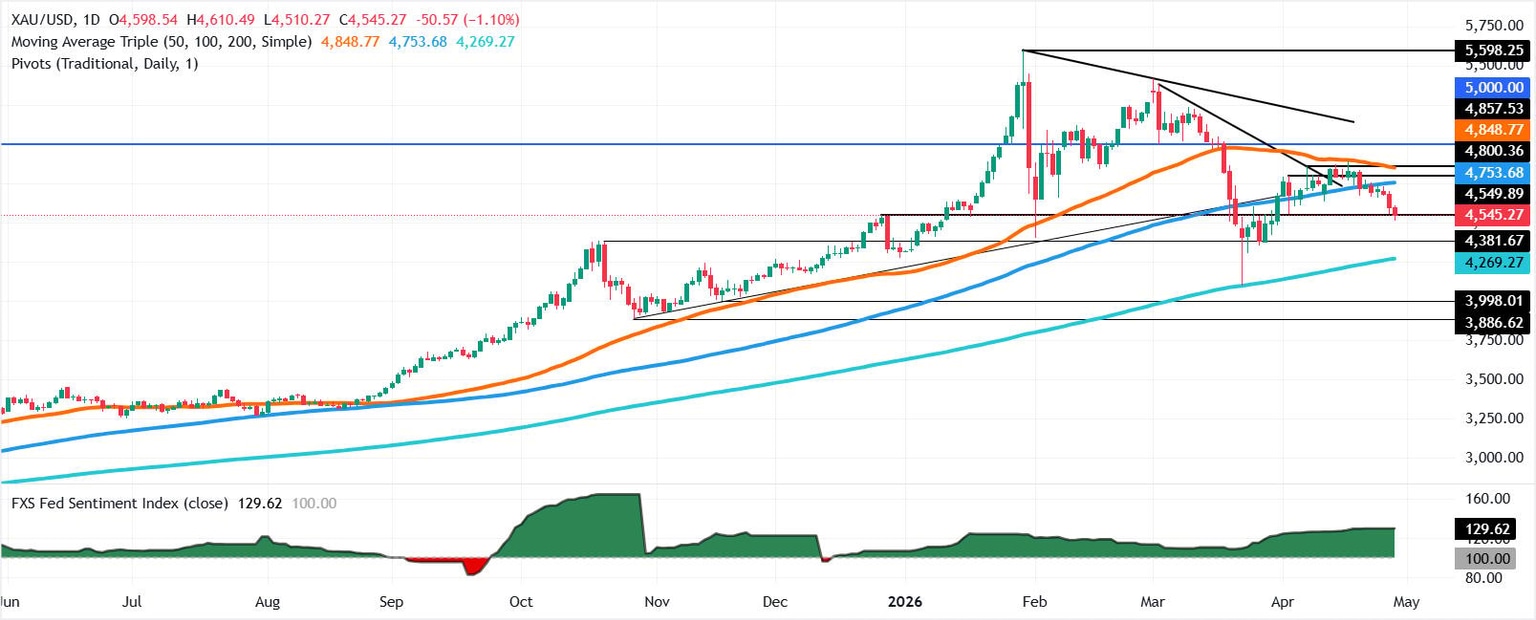
Gold (XAU/USD) price extends its losses over 1% as the Federal Reserve (Fed) held rates unchanged and its Chair Jerome Powell hinted that he would remain on the board until the criminal investigation against him is definitively dropped. The XAU/USD pair exchanges hands at $4,546 after reaching a daily peak of $4,610.
Bullion drops as Fed hold and stronger Dollar keep buyers on edge
In remarks of his last press conference as Fed Chair, Jerome Powell congratulated Kevin Warsh as he hurdled the first stage on his path to becoming his successor as Fed Chair. He said that he would stay as governor until political pressures die down, as he added that “Fed’s independence is at risk.” He added that “I want to stay until I will stay until it’s I feel it’s appropriate for me to leave,” adding that he would not be “a high profile dissident or anything like that.”
Earlier, the Federal Open Market Committee (FOMC) held rates at the 3.50%-3.75% range on a meeting featuring an 8-4 vote split, its most divided since 1992. Fed Governor Stephen Miran voted for a rate cut, while Fed Regional Bank Presidents Beth Hammak, Neel Kashkari and Lorie Logan voted against the “inclusion of an easing bias in the statement at this time.”
Traders digesting the recent news keep the Greenback bid, with the US Dollar Index (DXY), which measures the buck’s performance against a basket of six currencies, up 0.37%, at 98.96. The US 10-year Treasury note is rising eight basis points up at 4.43%, signaling that investors are pricing an inflation surge.
Fed’s interest rate probability table
At the time of writing, money markets had priced in a 29% chance for a rate hike by the Fed for April 2027 meeting, according to Prime Terminal data.
Data-wise, US Core Durable Goods Orders jumped by 3.3%, up from 1.6% in February and far above the expected 0.6% increase. This suggests that companies are boosting their spending, particularly on AI, to enhance profit margins. Overall goods orders also improved, rising from a yearly decline of 1.2% to a 0.8% gain, beating forecasts of 0.5%.
XAU/USD technical outlook: Bears push Gold to four-week lows, further downside eyed
Gold price is neutral to bearish, trading near four-week lows around $4,510, with momentum favoring further downside as the Relative Strength Index (RSI) approaches oversold territory.
If Gold drops below $4,500, the first support level would be the March 31 low at $4,482, followed by the March 26 swing low at $4,351. The next support would be the 200-day Simple Moving Average (SMA) at $4,269.
On the flip side, buyers must reclaim the $4,600 mark, followed by the 100-day SMA at $4,753. On further strength, the next resistance would be the 50-day SMA at $4,848.

Fed FAQs
Monetary policy in the US is shaped by the Federal Reserve (Fed). The Fed has two mandates: to achieve price stability and foster full employment. Its primary tool to achieve these goals is by adjusting interest rates.
When prices are rising too quickly and inflation is above the Fed’s 2% target, it raises interest rates, increasing borrowing costs throughout the economy. This results in a stronger US Dollar (USD) as it makes the US a more attractive place for international investors to park their money.
When inflation falls below 2% or the Unemployment Rate is too high, the Fed may lower interest rates to encourage borrowing, which weighs on the Greenback.
The Federal Reserve (Fed) holds eight policy meetings a year, where the Federal Open Market Committee (FOMC) assesses economic conditions and makes monetary policy decisions.
The FOMC is attended by twelve Fed officials – the seven members of the Board of Governors, the president of the Federal Reserve Bank of New York, and four of the remaining eleven regional Reserve Bank presidents, who serve one-year terms on a rotating basis.
In extreme situations, the Federal Reserve may resort to a policy named Quantitative Easing (QE). QE is the process by which the Fed substantially increases the flow of credit in a stuck financial system.
It is a non-standard policy measure used during crises or when inflation is extremely low. It was the Fed’s weapon of choice during the Great Financial Crisis in 2008. It involves the Fed printing more Dollars and using them to buy high grade bonds from financial institutions. QE usually weakens the US Dollar.
Quantitative tightening (QT) is the reverse process of QE, whereby the Federal Reserve stops buying bonds from financial institutions and does not reinvest the principal from the bonds it holds maturing, to purchase new bonds. It is usually positive for the value of the US Dollar.
Read the full article here