





Gold (XAU/USD) rises over 1% on Wednesday, even as the US Dollar (USD) trims some of its earlier losses, after the US Treasury Department announced a bond buyback for the September 10 auction of 10- and 20-year instruments. This, along with investors waiting for the release of US inflation data, keeps the yellow metal underpinned near $4,400 at the time of writing.
XAU/USD consolidates near $4,400 before key US inflation data
Price action favors further consolidation for Gold, which has traded between $4,340 and $4,400 over the last two days. The rise in US Treasury yields, following the US Treasury’s buyback announcement, pushed the 10-year benchmark note up five basis points to 4.845%, a headwind for the yellow metal.
The US Treasury said that it intends to buy up to $6 billion of outstanding securities set to mature in the 10- to 20-year tranche. This is the first operation under Secretary Scott Bessent’s leadership to cap the rise in US bond yields, particularly at the long end of the curve, from the 10-year to the 30-year.
Earlier, the US ADP Employment Change 4-week average was 12K, up from the previous week’s downward-revised 10K. This report, along with last Friday’s Nonfarm Payrolls print and Fed Chair Warsh saying that jobs data is “consistent with full employment,” paves the way for a rate increase if needed, following Thursday’s and Friday’s US inflation data.
Money markets indicate investors expect a quarter-point rate hike at the September 15-16 meeting. Odds stand at 63%, while hold odds are near 37%, according to Prime Terminal.
Besides US inflation data, traders will also eye the release of US Initial Jobless Claims and the preliminary release of the University of Michigan Consumer Sentiment Index for September.
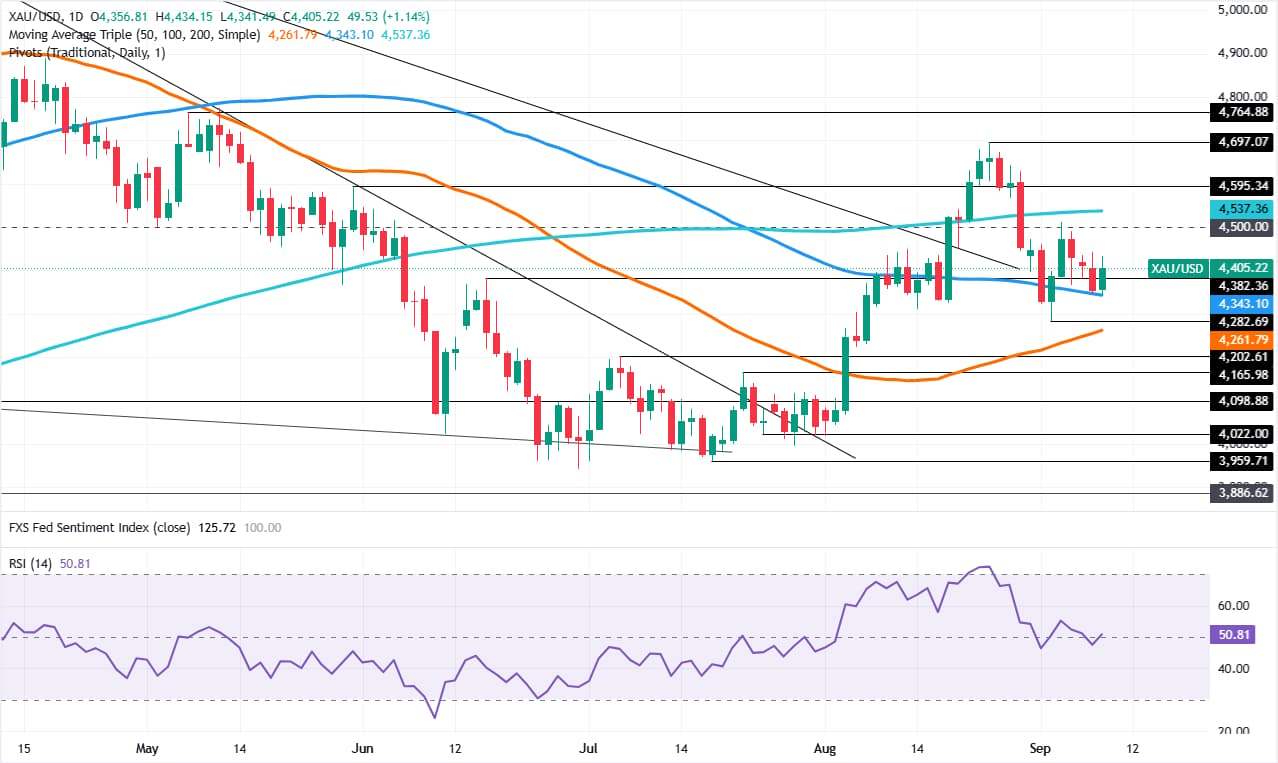
XAU/USD technical outlook: Gold bounces at the 100-day SMA, target on $4,450
Gold price bounced off solid support at the 100-day Simple Moving Average (SMA) of $4,343, though it continued to trade laterally. The Relative Strength Index (RSI) shows that buyers are gaining momentum, but key resistance at $4,425, the high of September 8, caps XAU’s advance, preventing a retest of the $4,500 figure.
If buyers reclaim $4,500, the next area of interest becomes the 200-day SMA at $4,537. A breach of the latter will expose $4,600, followed by the psychological $4,650 and the August 25 high of the day at $4,697.
Downwards, if Gold retreats beneath $4,400, the 100-day SMA is the first line of defense. If cleared, the next support is the September 2 cycle low of $4,282 followed by the 50-day SMA at $4,261, and by the figure at $4,200.

Gold FAQs
Gold has played a key role in human’s history as it has been widely used as a store of value and medium of exchange. Currently, apart from its shine and usage for jewelry, the precious metal is widely seen as a safe-haven asset, meaning that it is considered a good investment during turbulent times. Gold is also widely seen as a hedge against inflation and against depreciating currencies as it doesn’t rely on any specific issuer or government.
Central banks are the biggest Gold holders. In their aim to support their currencies in turbulent times, central banks tend to diversify their reserves and buy Gold to improve the perceived strength of the economy and the currency. High Gold reserves can be a source of trust for a country’s solvency. Central banks added 1,136 tonnes of Gold worth around $70 billion to their reserves in 2022, according to data from the World Gold Council. This is the highest yearly purchase since records began. Central banks from emerging economies such as China, India and Turkey are quickly increasing their Gold reserves.
Gold has an inverse correlation with the US Dollar and US Treasuries, which are both major reserve and safe-haven assets. When the Dollar depreciates, Gold tends to rise, enabling investors and central banks to diversify their assets in turbulent times. Gold is also inversely correlated with risk assets. A rally in the stock market tends to weaken Gold price, while sell-offs in riskier markets tend to favor the precious metal.
The price can move due to a wide range of factors. Geopolitical instability or fears of a deep recession can quickly make Gold price escalate due to its safe-haven status. As a yield-less asset, Gold tends to rise with lower interest rates, while higher cost of money usually weighs down on the yellow metal. Still, most moves depend on how the US Dollar (USD) behaves as the asset is priced in dollars (XAU/USD). A strong Dollar tends to keep the price of Gold controlled, whereas a weaker Dollar is likely to push Gold prices up.
Read the full article here