


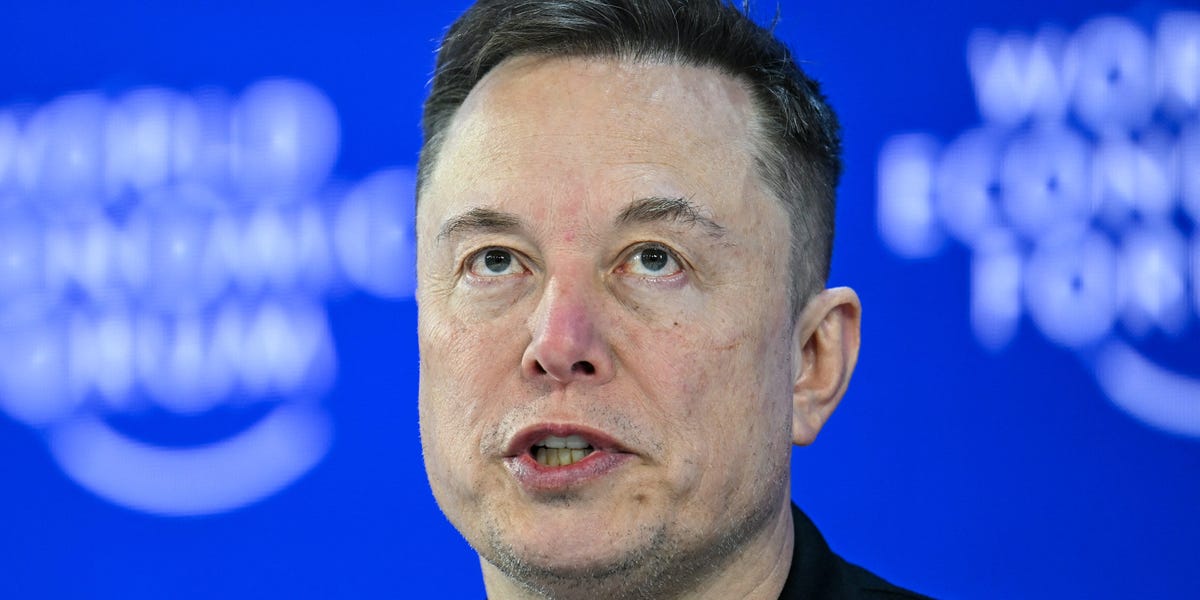
Elon Musk has achieved an initial win in his dispute with Germany’s public broadcaster ZDF: The network said it would remove language about Musk’s alleged role in the unrest in Northern Ireland from a program that aired last week.
That Musk is a controversial figure for German media is probably nothing new to the tech entrepreneur. But now he appears to have had enough of ZDF. On Monday evening, he announced on X that he would take “legal action” against the public broadcaster over what he called its “outrageous lies.”
The trigger was the introduction to the June 12 edition of the program “ZDFheute Live” in which presenter Christina von Ungern-Sternberg stated: “A brutal attempted murder in broad daylight in Belfast. Someone records it, the video goes viral. A racist mob then hunts migrants. The call to action came from a British far-right extremist and tech billionaire Elon Musk.”
Musk had not called for a hunt against migrants; he had shared a call for a demonstration posted by a far-right extremist.
On Tuesday morning, WELT reported that Hamburg-based attorney Joachim Steinhöfel had sent a legal warning letter to the broadcaster on Musk’s behalf. Around 2 p.m., ZDF confirmed that it had complied with the demand for a cease-and-desist declaration and told WELT: “ZDF has submitted the declaration and removed the passage in question from the introduction. As early as Saturday, ZDF had already added a transparency notice correcting the broadcast.”
With the cease-and-desist declaration, the broadcaster avoided a formal injunction lawsuit.
This may be the beginning of a longer dispute between Musk and ZDF. Earlier in the day, Steinhöfel told WELT by phone that he intended to propose that Musk review all ZDF reports about him from recent years—”at least those that are not yet time-barred”—for potential legal violations and pursue claims where appropriate.
“This is not the first case in which ZDF has commented on my client in a questionable manner,” Steinhöfel said.
Musk could also demand a correction or seek damages from ZDF. Tobias Gostomzyk, professor of Media Law at TU Dortmund, said he should not expect major compensation.
“Musk would have to specifically demonstrate and prove that the reporting caused him a measurable economic loss and that this loss was causally linked to the contested statement. In practice, such proof would be very difficult to provide,” the professor said.
Musk could make a claim for monetary compensation based on a violation of his general personality rights. According to established case law, such compensation is granted only in cases of serious violations that cannot be adequately remedied by other means, such as a correction, a right of reply, or an injunction.
“Even if the requirements were considered fulfilled in this case, any monetary compensation would likely be relatively modest,” Gostomzyk said.
Musk could also file suit in the United States.
“Legal action against ZDF in the United States would be conceivable if the report was received there. Given Elon Musk’s prominence, that seems likely. Many Germans, including significant investors, live in the United States,” Steinhöfel said, adding that he was not personally handling that question.
Hans-Jürgen Homann, who is licensed to practice law in both Germany and the United States, said Musk’s legal position as a “public figure” would likely be weaker in the US, where freedom of the press enjoys broader protection than in Germany.
This story originally appeared on WELT and is courtesy of the Axel Springer Global Reporters Network, which harnesses the resources of the company’s newsrooms to publish ambitious scoops, investigations, interviews, opinion pieces, and analysis. It allows journalists — including those from POLITICO, Business Insider, WELT, BILD, Onet, and Fakt — to collaborate on major stories for an international audience of hundreds of millions across platforms.
Read the full article here