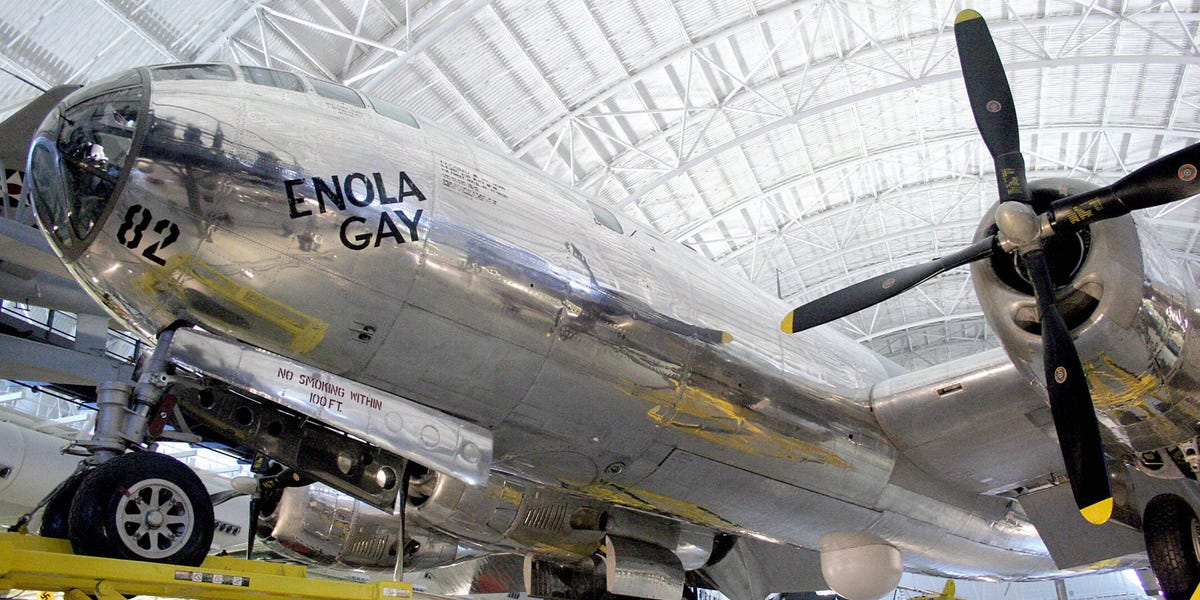
The Steven F. Udvar-Hazy Center in Chantilly, Virginia, features over 200 aircraft and spacecraft on display, but Enola Gay remains one of the most prominent — and controversial — objects in its collection.
The Boeing B-29 Superfortress bomber, which dropped the first atomic bomb on Hiroshima during World War II, is so large that it couldn’t fit into the Smithsonian National Air and Space Museum’s flagship location on the National Mall in Washington, DC.
Instead, Enola Gay is displayed about 30 miles away at the museum’s larger second location, the Udvar-Hazy Center.
Exhibiting Enola Gay sparked intense debate in the 1990s when it was first displayed, as interest groups disputed how the plane’s legacy and the role of the atomic bomb in World War II should be portrayed.
As the world marks the 81st anniversary of the 1945 bombing of Hiroshima on August 6, here’s a closer look at the historic aircraft.
Enola Gay dropped the first-ever atomic bomb used in warfare on Hiroshima on August 6, 1945.
A second “Fat Man” atomic bomb was dropped on Nagasaki on August 9, 1945, by another Boeing B-29 Superfortress named Bockscar, which is on display at the National Museum of the US Air Force in Dayton, Ohio.
Japan’s emperor announced the nation’s surrender in a radio address six days later, on August 15.
The plane was named after pilot Paul Tibbets’ mother, Enola Gay Tibbets.
Tibbets commanded the Army Air Forces’ 509th Composite Group, which was responsible for deploying nuclear weapons. The hand-picked unit trained at an airfield in Wendover, Utah.
The “Little Boy” atomic bomb deployed by Enola Gay weighed 9,700 pounds.
To make the B-29 aircraft capable of carrying the atomic bomb, all of its protective and defensive armament, except for the 50-caliber tail guns, were removed to get rid of excess weight. It was also left unpainted, saving the 850 pounds that the paint would have added.
The bomb exploded 1,900 feet above Hiroshima with devastating effects.
Roughly 70,000 people died from the effects of the initial blast, heat, and radiation from the bombing of Hiroshima, and the death toll over five years may have exceeded 200,000 people due to the aftereffects, according to the US Department of Energy’s Office of History and Heritage Resources.
Japan and anti-nuclear weapons scientists released a higher estimate in the 1970s, counting 140,000 deaths at Hiroshima.
The Enola Gay was rattled by shockwaves from the explosion even though it had already flown 11.5 miles away.
Enola Gay spent decades in storage before the Smithsonian began restoration work on the bomber in 1984.
It took museum staff 300,000 hours to reassemble and restore Enola Gay, with 12 truckloads to transport all its parts.
Enola Gay first went on display in 1995, and the historical narratives around the use of the atomic bomb were fiercely debated.
In 1995, the fuselage and other parts of the Enola Gay were displayed at the National Air and Space Museum’s flagship location in Washington, DC, as part of an exhibit tied to the 50th anniversary of the bombing of Hiroshima.
The script of the exhibit was rewritten several times as various interest groups debated how it was presented and how the decision to drop the bomb was framed, according to the Smithsonian Institution Archives.
Veterans’ groups pushed for the exhibit to emphasize Japanese aggression and present the narrative that dropping the atomic bomb saved lives by ending the war. Anti-war activists opposed having the exhibit justify the use of the bomb and sought to highlight its victims by protesting with alternative exhibits on the sidewalk outside the museum.
Enola Gay went on permanent display at the National Air and Space Museum’s Steven F. Udvar-Hazy Center in 2003.
Weighing 137,500 pounds with a wingspan of 141 feet, the fully assembled plane is too large for the National Air and Space Museum’s National Mall location, which features 161,145 square feet of exhibit space.
The Steven F. Udvar-Hazy Center in Chantilly, Virginia, offers more room with 340,000 square feet of exhibit space.
The Udvar-Hazy Center features an elevated walkway, allowing visitors to view the plane from above as well as on the ground.
The Enola Gay is among the museum’s collection of 30 World War II-era American military aircraft, including the Northrop P-61C Black Widow, the first US aircraft designed for night combat.
The Enola Gay stands out as one of the museum’s most historically significant aircraft.
81 years after the bombing of Hiroshima, the Enola Gay remains not just a World War II artifact, but a symbol of a turning point that ushered the world into the nuclear age.
After years of debate over how to present the aircraft, the permanent exhibition takes a minimalist approach, leaving visitors to decide how to understand its legacy.
Editor’s Note: This story was originally published in February 2026 and updated in August 2026.
Read the full article here