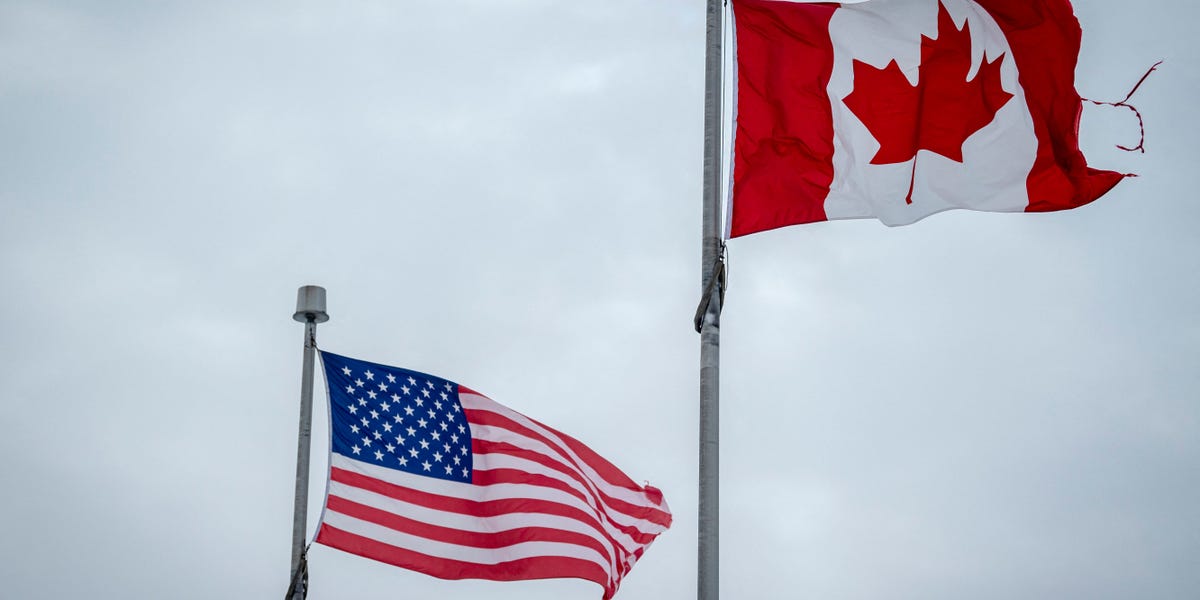
Canadians aren’t visiting the US as much as they used to since President Donald Trump’s return to the Oval Office in 2025.
His presidency has focused on aggressive trade policies, heavy US tariffs on Canadian goods, and rhetoric on turning the northern country into a US state.
Trade tensions between the two countries have only continued into 2026, with the Trump administration on Saturday imposing 50% tariffs on various Canadian items, including alcohol and hockey equipment.
Trump says the tariffs are retaliation for Canadian trade policies that he argues put US producers at an unfair disadvantage.
Trump further threatened to impose a 50% tariff on Canadian-made steel, which could also apply to trucks and auto parts, starting on January 1. That threat was met with a similar one from Canadian Prime Minister Mark Carney, who said Canada would match the US’ tariffs “dollar-for-dollar.”
Those trade tensions have had a negative ripple effect on US states that depend on Canadian tourism and visitor spending.
Canadians pulled back on leisure travel to the US in 2025, according to Statistics Canada data. Visitor numbers rebounded over the past year but remain below 2024 levels.
To determine which places could be most affected by the drop in visitors, Tourism Economics estimated the decline in Canadian visitor spending in each state in 2025 compared with 2024, then divided that projected loss by the state’s resident population, using Census Bureau population data.
The figures show the projected loss in Canadian visitor spending per state resident. The 15 places with losses above the $11 national average indicated “strong dependence on Canadian travel,” Tourism Economics wrote.
The analysis was published in September 2025 and therefore includes 2025 forecasts rather than actual spending figures.
Tourism Economics identified the following 15 places — 14 states and Washington, DC — as more dependent on Canadian travelers and therefore more likely to experience losses greater than average.
Here are the 15 places, ranked from least to most affected.
15. Massachusetts
Massachusetts was estimated to lose $12 per state resident in 2025 due to lower Canadian tourism levels. That’s just above the expected national average loss of $11 per US citizen.
14. New Hampshire
New Hampshire, which borders Canadian towns east of Montreal, was expected to lose $13 per state resident due to the drop in Canadian tourism.
The state saw the biggest drop in international overnight visitors in 2025, according to an Oxford Economics study, by 23.1%.
12. Montana (tie)
Montana’s economy was projected to lose $14 per state resident following tensions between the US and Canada.
The state saw a 17.7% drop in international overnight visitors in 2025, too.
12. Oregon (tie)
Oregon, which is separated by one state — Washington — from Canada, faced an approximate $14 drop per state resident.
11. New York
New York, which shares a border with Canada, was expected to lose $15 per state resident.
The state was not included in the Oxford Economics study of international overnight visitor arrivals to the US.
10. North Dakota
North Dakota sits just below two Canadian provinces: Saskatchewan and Manitoba. It was forecast to lose $18 per state resident due to declines in tourism, and reported the third-highest drop in international overnight visitors, at 21.5%.
9. Arizona
Arizona does not border Alaska. Still, the Grand Canyon State was expected to see a loss of $22 per state resident as fewer Canadians traveled there.
8. Florida
Florida, which has previously listed Canadians as the state’s top international visitors, was expected to lose $23 per state resident.
7. California
California does not border Canada, but was expected to lose $31 per state resident.
The state was not included in the Oxford Economics study of international overnight visitor arrivals to the US.
6. Maine
Maine neighbors southern Quebec, with Portland, the state’s most visited town, just a five-hour drive away.
The state was expected to see a $32 decrease per state resident following the drop in Canadian tourism, and saw a 20.9% drop in international overnight visitor arrivals in 2025.
5. Vermont
Vermont shares a small border with Canada — only 90 miles total — but was expected to see a $37 decrease per state resident.
It’s the second-most state to have witnessed a drop in international overnight visitor arrivals last year, too, at 22.6%.
4. Hawaii
The Aloha State is the farthest state away from Canada at roughly 2,500 miles, but it was expected to see a $45 decrease per state resident due to declines in tourism.
3. District of Columbia
The District of Columbia was expected to see a $61 decrease per resident.
2. Nevada
Nevada does not border Canada. Still, the home state of Las Vegas, one of the top travel destinations across the country, was expected to see a $77 decrease per state resident.
1. Alaska
Alaska borders Canada more than any other US state, sharing a total of 1,538 miles.
The economic loss per state resident nearly doubles Nevada, with the state expected to lose $114 per capita due to US and Canada tensions.
The state also witnessed a 13.9% drop in international overnight visitor arrivals last year.