




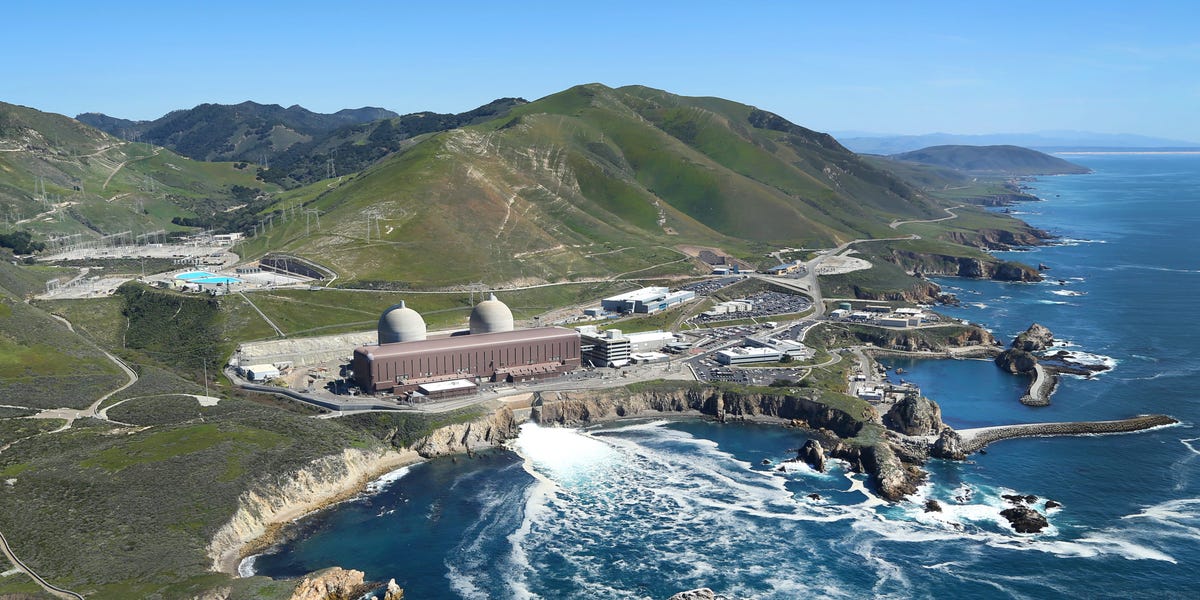
In 2016, Pacific Gas and Electric planned to wind down its utility operations at the Diablo Canyon Power Plant in California by 2025, citing concerns from environmental advocates about the plant’s location near the water and atop several fault lines.
But in September 2022, PG&E received unexpected news from the state: Gov. Gavin Newsom had signed SB 846 into law, extending the nuclear power plant’s operations through October 2030.
“We had to pivot to continue to operate,” Maureen Zawalick, PG&E’s senior vice president and chief risk officer, who has worked at the company for 30 years, told Business Insider.
With deadlines for regulatory applications approaching — a requirement by federal and state agencies to keep Diablo Canyon running — and job attrition due to the previously planned shutdown, Zawalick said she saw value in turning to AI to streamline PG&E’s paperwork process.
In January 2024, Zawalick agreed to meet with Trey Lauderdale, a local resident and the CEO and founder of Atomic Canyon, an artificial intelligence startup focused on building a ChatGPT-like search tool for the nuclear energy sector.
Lauderdale’s past expertise in healthcare, which operates with a lot of regulatory burdens, influenced his interest in nuclear power, in addition to his location: His family was living 25 miles from Diablo Canyon, he told Business Insider. He envisioned developing an AI solution that would ease the burden of the nuclear power industry’s administrative expenses.
Together, PG&E and Atomic Canyon created the first-ever commercial installation of an on-site generative AI tool at a US nuclear power plant. The AI tool, called Neutron, was designed to make it easier for Diablo Canyon’s workers to find and use the millions of documents that are legally required to be kept on file, Zawalick said.
The nuclear sector is tightly regulated at both the federal and state levels, so workers have large amounts of paperwork and data to manage. At Diablo Canyon, billions of data points — including engineering records, design updates, and regulatory filings — are spread across six systems and stored on-site. Neutron connects to all of these systems via the internet, not the cloud, so staff can use the AI tool with a simple web-based search on their computers at the plant.
The tech
In December 2023, Lauderdale formed Atomic Canyon and hired AI engineers whom he knew from the healthcare sector.
His plan was to build a generative AI tool that could understand nuclear terminology better than OpenAI’s ChatGPT or Anthropic’s Claude. To train the AI model on the correct terminology, Atomic Canyon’s team downloaded 53 million pages of publicly available industry data from the Nuclear Regulatory Commission, a government agency that regulates commercial nuclear power plants, said Lauderdale.
Then, in May 2024, Atomic Canyon announced a project with the Department of Energy’s Oak Ridge National Laboratory, based in Tennessee. The lab said Lauderdale’s team could implement a supercomputer, called Frontier, to train Atomic Canyon’s AI model on its trove of nuclear terms.
In November 2024, PG&E announced that it had selected Atomic Canyon to develop what would become Neutron at Diablo Canyon.
Neutron helps PG&E employees retrieve documents about operating and maintenance procedures, past engineering design changes, and state and federal regulatory requirements.
“We have over 9,000 procedures to operate and maintain the plant,” Zawalick said. At the 40-year-old Diablo Canyon, there are billions of pages of data to track and analyze. “And we’re just one power plant,” she added.
Previously, workers had to crawl multiple systems to find all that information. With Neutron, they retrieve those details from a single database built and run on AI chipmaker Nvidia’s AI platform.
In the first half of 2024, PG&E piloted Neutron with a small beta-test group that included employees from the engineering, maintenance, and operations teams, Zawalick said.
Beginning in July 2025, PG&E rolled out Neutron in phases, including training sessions to teach employees how to use the AI-enabled search tool, Zawalick said. By the fall of 2025, it was made available to all 1,300 workers at Diablo Canyon.
The outcome
As of January 2025, Neutron’s search and generative AI summaries have significantly reduced the total time required to find documents, a PG&E spokesperson told Business Insider.
Zawalick shared one case study of how this works: For an investigation into a safety valve issue at Diablo Canyon, a team of 12 employees would previously have been formed to retrieve all necessary documentation before any work could be done to fix the valve. Typically, this project would have taken about 180 days, Zawalick said. With Neutron, a team of the same size could retrieve all of the necessary documentation within 40 days.
In the future, Zawalick is hopeful that generative AI tools like Neutron will make it easier for utilities to build new solar, wind, or nuclear facilities to meet the growing US energy demand.
“A tool like this will really help with regulatory filings, construction, and engineering,” Zawalick said.
Read the full article here