


Copy link
X
Bluesky
Threads
Impact Link
Save
Saved
Read in app
subscribers. Become an Insider
and start reading now.
Have an account? .
- Bill Ackman, Palmer Luckey, Garry Tan, and more are sharing their opinions on a California wealth tax proposal.
- State labor groups proposed a 5% tax for California residents whose assets exceed $1 billion.
- Ackman called for a “fairer tax system”; Tan wrote that he would consider opening Y Combinator programs in other cities.
Some of the biggest names in business are speaking up about California’s billionaire tax proposal.
The measure proposed a one-time 5% tax for California residents whose assets exceed $1 billion. If the proposal receives enough signatures, it would appear on the state ballot in November.
If the proposal passes, the tax would apply retroactively to all California residents as of January 1, 2026.
Proposed by the Service Employees International Union-United Healthcare Workers West labor union, the bill attempts to fill a projected multibillion-dollar state budget deficit.
California is home to some of the biggest companies — in both value and prestige — in the US. The state boasts Hollywood and Silicon Valley, although some of the industries’ key players have relocated.
In a letter to Gov. Gavin Newsom obtained by Business Insider, attorney Alex Spiro wrote that his clients would “permanently relocate” if the tax becomes law. Spiro has previously represented billionaires and celebrities.
Here’s how several business leaders and politicians have reacted to the tax proposal:
Bill Ackman
The billionaire CEO of Pershing Square Holdings wrote Monday on X that he was “opposed to wealth taxes because they effectively represent an expropriation of private property,” which can have “unintended and negative consequences.”
However, he said he’s in favor of a “fairer tax system.”
For example, Ackman wrote that an individual who had amassed a billion dollars or more in wealth could pay no personal income tax by living off loans secured by stock in their company. A change in the tax code could fix that problem, he wrote.
“One shouldn’t be able to live and spend like a billionaire and pay no tax,” Ackman wrote.
As for California’s “budget problems,” Ackman wrote that the issue wasn’t a lack of tax revenue — it was about “how the money is being spent.”
David Sacks
The White House AI and crypto czar took aim at California’s government in an X post on Sunday.
Red states like Texas and Florida don’t employ state income taxes, let alone wealth taxes, Sacks wrote. “Democrats steal everything, then blame job creators for their ‘greed,'” he wrote.
Sacks said in an October episode of the “All-In” podcast, which he cohosts, that a wealth tax “always backfires,” because tax benefits are outweighed by wealthy residents leaving.
Sacks threatened to leave the state, analogizing steady tax increases to boiling a frog on the podcast.
“I’m going to have to jump out of the pot with this,” he said.
Ro Khanna
The Congressman for California’s 17th district, which covers much of Silicon Valley, said that the proposal was “good for American innovation.”
After receiving thousands of comments on a Friday post bidding a sarcastic goodbye to those threatening to leave the state, Khanna explained his support in a seven-paragraph X post on Saturday.
He wrote that Nvidia would be built all over again, even with the wealth tax.
“Jensen [Huang] wasn’t thinking I won’t start this company because I may have to one day pay a 1% tax on my billions,” Khanna wrote. “He built here because the talent is here.”
Khanna argued that innovation would be further stifled by the “political dysfunction and social unrest” that comes with wide wealth gaps.
In a statement to Business Insider, Sarah Drory, a spokesperson for Rep. Khanna, wrote that the representative has “always supported a modest wealth tax on billionaires to deal with staggering inequality and to make sure people have healthcare.”
“He has advocated for common sense workarounds for startup founders whose companies are not profitable and who have illiquid stock,” Drory wrote.
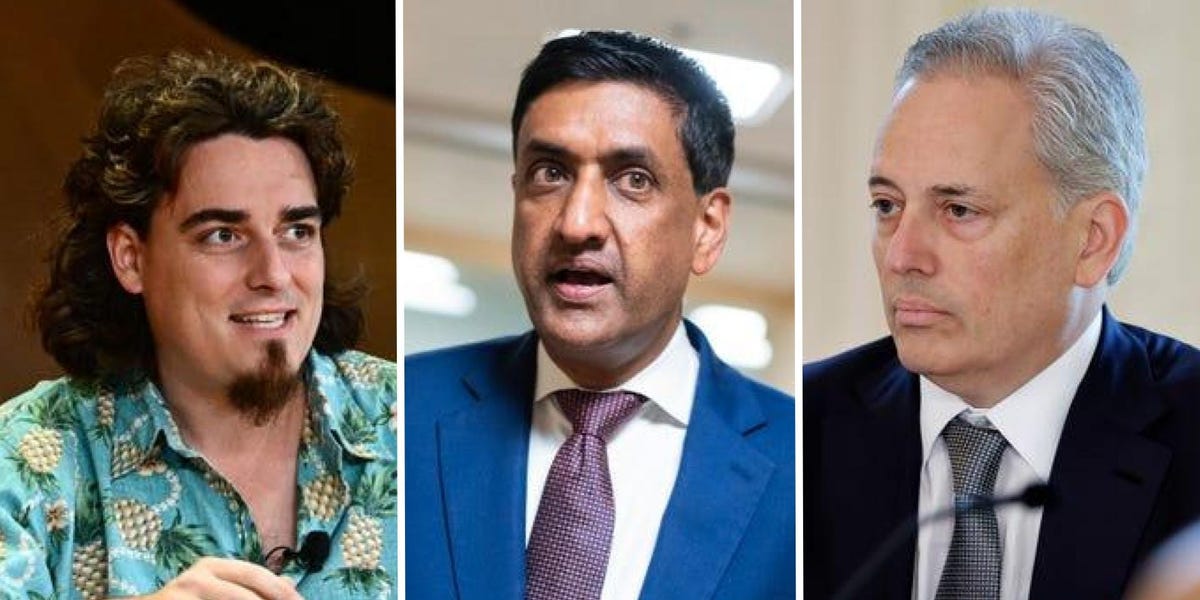
Palmer Luckey
The Oculus founder and Anduril cofounder wrote in a Sunday X post that the tax would force founders to “sell huge chunks of our companies.”
Luckey wrote that he made money from Oculus — which he sold to Facebook in 2014 — and paid millions in taxes on it. Then he used the “remainder” to start Anduril, he wrote.
“Now me and my cofounders have to somehow come up with billions of dollars in cash,” Luckey wrote.
Luckey also wrote that the policy made no provision for companies that funnel revenue back to research and development, rather than paying cash incomes sizable enough to cover the tax.
“You are effectively forcing companies to immediately pivot into profit obsession over mission or long-term sustainability,” he wrote.
Garry Tan
The CEO of startup accelerator Y Combinator wrote in a Saturday X post that the tax would “kill little tech in California.”
Unicorn startup founders become a “paper billionaire” — as in, having cash on hand — around the $5 billion valuation point, Tan wrote.
The proposed tax is on unrealized gains, meaning founders would be put on the line even before their wealth is liquid, Tan wrote.
If the tax passed, Tan wrote that Y Combinator would consider opening Austin or Cambridge programs.
Bernie Sanders
The Vermont senator has long been a proponent of taxes on the wealthy, introducing a bill in 2019 that aimed to halve the wealth of billionaires over a 15-year period.
While Sanders didn’t explicitly comment on the California proposal, he posted Monday on X broadly supporting wealth taxes.
“We can respect innovation & entrepreneurship, but we cannot respect the extraordinary greed that now exists,” Sanders wrote. “We need a wealth tax.”
Elon Musk
The Tesla CEO reposted another user’s X post that commented on the tax, saying that his stocks weren’t wealth.
Musk wrote in his Tuesday post that his “wealth” was mostly tied up in Tesla and SpaceX shares.
“This means my ‘wealth’ can only increase due to producing more products and services for the public,” he wrote.
While not directly commenting on the California tax, Musk wrote that he was a “maker,” unlike “taker” politicians like Sanders.
Musk said in 2020 that he had moved from California to Texas.
Gavin Newsom
The governor of California has spoken against the wealth tax. At The New York Times’ Dealbook conference in December, Newsom said that California had to stay competitive with other states.
“People of that status, they already have two or three homes outside the state,” he said. “You’ve got to be pragmatic about it.”
If the tax passes as a ballot measure, Newsom would not have the ability to veto it.
Read the full article here