





Not so long ago, Brené Brown’s ideas about vulnerability as a leadership virtue were not only uncontroversial, they were embraced in corporate America. No longer.
Today, CEOs are conducting sweeping layoffs, dressing them up as productivity gains. They’re ratcheting up the pressure on their remaining teams, cracking down on dissent, tracking their workers’ every keystroke, and pouring billions into the all-consuming infrastructure of AI projects while scaling back their investment in employees. This is the new reality, they say. If you don’t like it, get out.
“If you are an asshole leader,” Brown told me, “you have never had more cover than you have right now to continue that behavior, because of the strong-man authoritarianism we’re seeing.” The author and researcher said she had “the behavior of a lot of tech leaders right now” in mind.
“Courageous leaders do not change who they are based on the political climate,” she said. “They don’t look to see, ‘Oh, empathy’s not in style today, I think I’ll have less of that.'”
“Does that bring a level of scrutiny to leaders when the president of the United States — or the president of whatever country they’re operating from — predominantly has a different perspective? Yeah, it does. It really does. But zero excuses.”
If you are an asshole leader, you have never had more cover than you have right now.
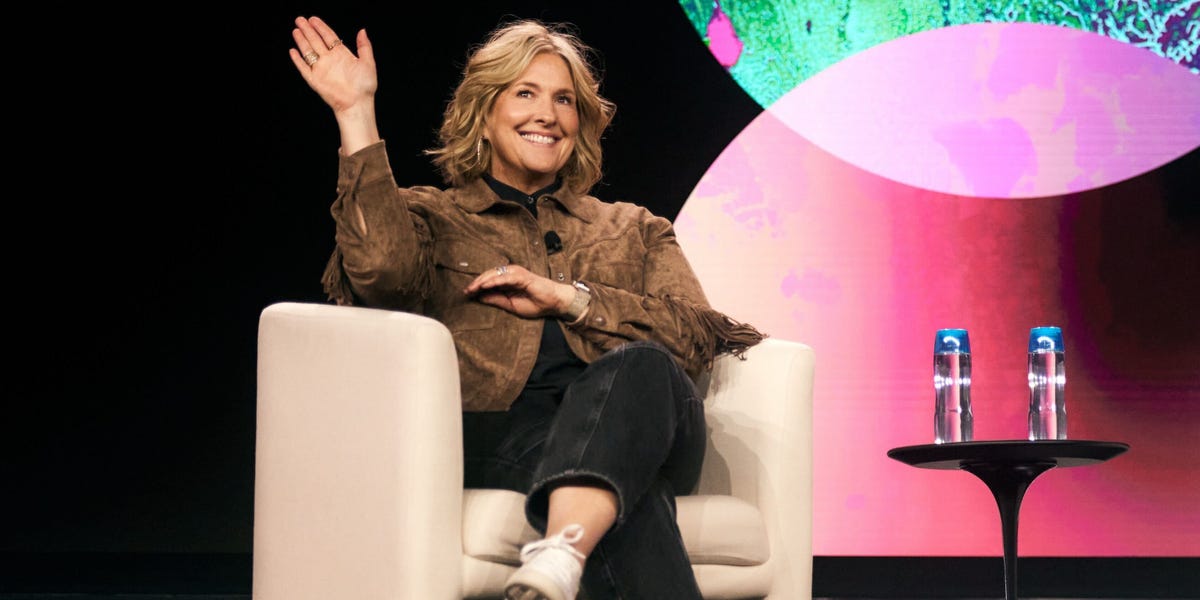
Brown met me this month in a hotel in San Francisco, on the sidelines of a conference hosted by the coaching platform BetterUp. It’s been 16 years since she gave a viral TED talk on her research on shame and vulnerability that’s probably made more people cry than anything else on the internet (it now has nearly 100 million views). In person, she was exactly as she was in the TED talk: warm and disarming, rarely breaking eye contact, and quick to offer self-deprecating quips that kept me laughing through the interview.
Since catapulting to fame, Brown has taken her research and applied it to the workplace, creating a leadership curriculum that was acquired by BetterUp. Today, as executive chair of the Center for Daring Leadership, she’s embedded inside organizations such as power management giant Eaton and enterprise network provider Lumen Technologies.
I asked Brown what she’s hearing right now from the CEOs she works with, and she emphasized the instability of the current moment. Even the executives running successful businesses, she said, are standing atop crumbling mountains — crumbling because of forces like AI, changing markets, and geopolitics.
“No matter what past accomplishments they have, there’s no planting a flag at the top of the mountain and saying, ‘We need to maintain this win,'” she said. “If you want to play to win, you’re going to have to look out at the next peak and make a jump. And not only do you have to go, you have to bring everyone with you.”
You have to bring everyone with you was the message Brown kept returning to in our conversation — a message repeated by the other speakers at BetterUp’s conference as well. Inside ballrooms packed with a crowd of mostly mid- to senior-level HR professionals, that idea still felt like a given. Outside, in much of corporate America, the vibe is very different. Speaking to several of the attendees, I got the sense that they were in their happy place, a temporary oasis — even if they knew they would soon be returning to an uglier reality that has grown particularly bleak for them in recent years.
After a couple years of nudging employees, many companies have lost their patience. AI use has become mandatory and tied to performance reviews, and ominous threats along the lines of “AI or else” are everywhere. Brown, though, holds that a successful transition requires something more difficult: fostering trust among employees and giving them a sense of agency. “We cannot feel like AI is happening to us,” she told me. “There’s not a CEO alive that doesn’t know that there’s nothing harder than building trust on teams and creating a sense of agency.”
Given the magnitude of the shift underway, I wondered whether tech CEOs have grown harsh in recent years because they’re scared.
“Would not invest an ounce of time or energy trying to diagnose their behavior,” she told me. “Don’t care. What’s driving it is of less interest to me than what it’s creating.”
What would happen if Elon Musk went through her program?
“Fortunately, a reality I don’t have to contemplate,” she said.
I asked Brown what mistakes she’s seeing CEOs make in the AI transition. One that stood out to her is implementing an AI strategy that has nothing to do with their business goals. She acted out how that looks: “‘Hey, give me an AI strategy.’ ‘That does what?’ ‘I don’t give a shit, just give it to me.'”
We cannot feel like AI is happening to us.
Another mistake she pointed to was failing to invest in employees, focusing all the attention on the technology itself. “In the end, it’s still your people driving your business,” she said. Although, she added: “I can see the seduction to invest in the non-messy thing.”
Despite these misgivings, Brown isn’t anti-AI. She’s built her own AI agent, feeding it “everything I wanted it to know about me and how I wanted it to think about what it told me.” It creates briefings for her ahead of meetings with the executives she advises — although she’s also found herself peppering it with personal questions too, like whether she should add creatine to her supplement stack. Laughing, she described its tendency to roast her. “It’s not sycophantic at all,” she insisted. Recently, it deadpanned, “Hard to believe you’re a social scientist sometimes.”
Toward the end of our conversation that largely focused on executives, I asked her about rank-and-file employees. Many of the white-collar workers I’ve been talking to are wrestling with a confusing mix of feelings about AI — thrilled with the ways it’s been useful, and terrified of what it means for their jobs. They’re not sure how to reconcile the two. What should they do? “The ability to hold this tension of paradox is an absolute leadership superpower moving forward,” she said. “I love this. I hate it. I can’t wait to get on it and I’m scared to death about it.“
She’s hopeful but also fearful herself — in part because she has Gen Z kids, but also because she’s worried for the world.
“The thing that scares me the most is we will never replace some of the best things about us that make us human, but we are very D-minus in the things that make us human,” she said. “An overwhelmed citizenry will default to hypernormalizing and choosing certainty. And that scares me. That scares me for companies, but it really scares me for democracy.”
Aki Ito is a chief correspondent at Business Insider.
Business Insider’s Discourse stories provide perspectives on the day’s most pressing issues, informed by analysis, reporting, and expertise.
Read the full article here