










The U.S. is showing signs of a “K-shaped” economy with spending among lower-income consumers showing little growth in comparison to their higher-income counterparts, a new analysis from the Bank of America Institute shows.
Internal data detailed in the report showed that in November the three-month average of total card spending reflected a K-shaped pattern as the holiday season began in earnest.
“In terms of overall credit and debit card spending, we’ve really seen a divergence open up since around the sort of spring, early summer in our data,” David Tinsley, senior economist at the Bank of America Institute told FOX Business in an interview.
“Currently, higher-income households – that’s the top third of households by income – their growth in spending is around 2.6% year-over-year, but for lower-income households, it’s only at 0.6%,” Tinsley noted. “That’s quite a big gap.”
US ECONOMY EXPECTED TO GROW FASTER IN 2026 DESPITE STAGNANT JOB MARKET: GOLDMAN SACHS
“I think there are kind of two legs to that story. One is the labor market: when you look at wages going into people’s bank accounts in our Bank of America data, we’re seeing higher income wage growth of around 4%, and lower income wage growth of around 1.4%, and that’s very close to the largest gap for around 10 years in the data,” he explained. “So on the income side, the K-shape is very apparent too.”
| Ticker | Security | Last | Change | Change % |
|---|---|---|---|---|
| M | MACY’S INC. | 22.05 | -0.09 | -0.41% |
| WMT | WALMART INC. | 114.36 | -0.47 | -0.41% |
| TGT | TARGET CORP. | 98.01 | -1.04 | -1.05% |
| AMZN | AMAZON.COM INC. | 227.35 | +0.59 | +0.26% |
“The other leg in a sense is wealth, equity market gains,” which Tinsley noted have mostly accrued to middle- and higher-income households who generally hold those equities.
“The market being relatively strong over the last sort of two to three years is really tending to underpin the consumer spending of the upper income households,” he added.
NEARLY 1 IN 4 AMERICAN HOUSEHOLDS LIVING PAYCHECK TO PAYCHECK, REPORT REVEALS


Trends in the labor market are likely a key driver of the K-shaped dynamics seen among consumers, the report noted.
After-tax wage and salary growth among lower-income households has continued to lag that of higher-income households, while the deceleration of lower-income wage growth that prevailed in the spring and summer appeared to level off in November, the Bank of America Institute reported.
The K-shaped pattern impacting consumers across income groups was also seen in the firm’s data covering spending on holiday items.
US ECONOMY GREW MUCH FASTER THAN EXPECTED IN THE THIRD QUARTER, DELAYED REPORT SHOWS
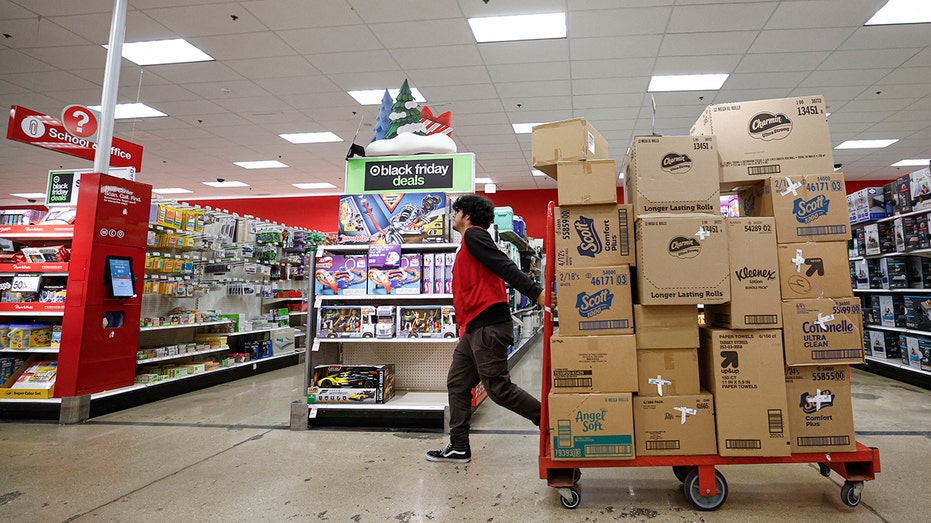
The Bank of America Institute found that while lower-income households had relatively healthy spending growth, they continued to lag middle- and higher-income households, and the report noted that the lower-income cohort had the weakest holiday spending growth in the week leading up to Cyber Monday.
The report also found that consumers have been price sensitive during the holiday season and that the growth in spending appears to have been driven by more transactions, with average spending per transaction having changed little. For online holiday purchases, transactions were up about 10% while the amount spent was up roughly 9%.
“People do seem to be doing quite an effective job avoiding or mitigating price rises from things like tariffs. What we’re seeing is that the volume of goods that they’re buying in terms of holiday spend is roughly on a par with the dollars they’re spending,” he explained.
“They seem to be making kind of good use of online, being quite price sensitive. They’re wringing quite a lot of volume out of their dollars,” Tinsley added.
Read the full article here


