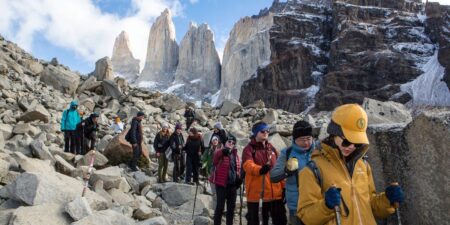






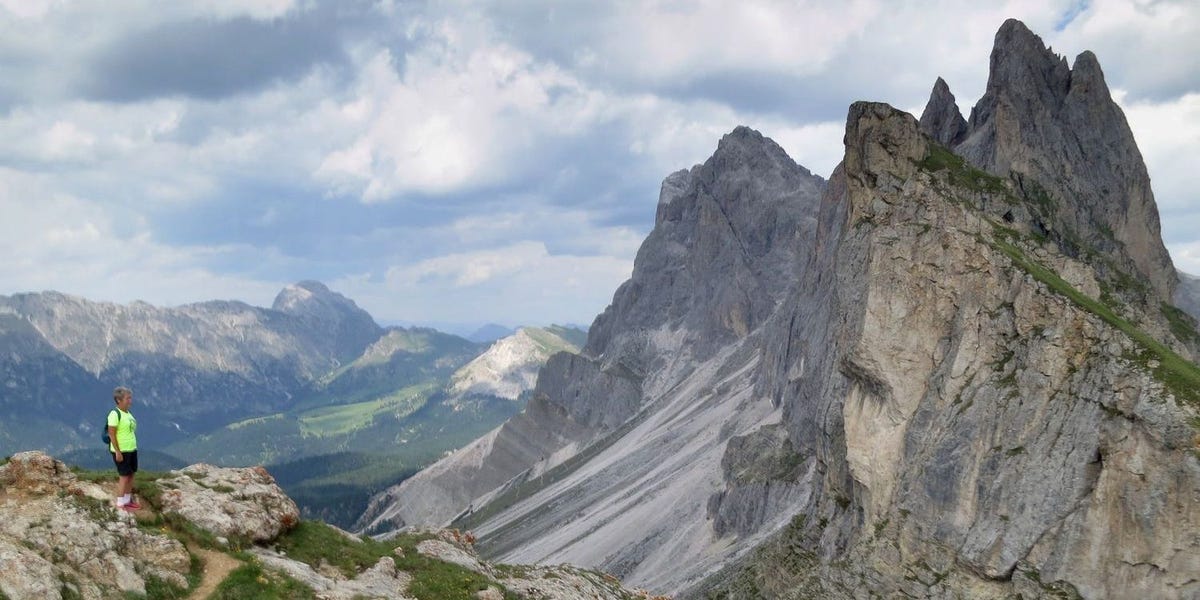
For more than 40 years, my husband Barry and I have undertaken long-distance walks throughout the world, usually coinciding with a milestone birthday
The year I turned 30, we hiked the Muktinath trail in Nepal; at 40, the Inca Trail to Machu Picchu; at 50, the Camino de Santiago; at 60, the Coast-to-Coast across northern England; and at 70, Hadrian’s Wall, near the Scottish border.
Barry is now 83, and I’m 74, but we have no intention of stopping. In the last two years, we did shorter treks in the Ecuadorian Andes and the silvery-spired Italian Dolomites.
We’re not uber athletes, but we’ve found that as long as you’re in reasonable health, you can always keep walking. It’s true, though, that some hikes are more challenging than others. During our Machu Picchu trek, for instance, the Inca steps were so steep, I don’t know how anyone could clamber up and down them. My knees are happy we did that trek when I was 40!
Over the years, we’ve gained some hard-earned insights from our walks.
Beauty can be very simple
We’ve climbed to elevations of 18,000 feet in the Himalayas, and a humble 1,200 feet in the countryside near Hadrian’s Wall. Yet that simple landscape, consisting of ordinary green fields, hills, and stones, took my breath away.
Long-distance walking abroad isn’t the same as backpacking
Walking is much cushier than backpacking. On our overseas walks, we sleep in beds, not on the hard ground. We stay in guesthouses, hostels, mountain huts, or B&Bs, and don’t schlep food or cooking gear, because our hosts serve us home-cooked meals or we eat in budget-friendly restaurants.
The walking environment isn’t the same, either. The Himalayan “wilderness,” for example, is filled with yaks, shepherds, climbers, hikers, and porters. There are no shepherds when Barry and I hike back home in California.
Preparation is key
On the Coast-to-Coast, our fellow hikers were well-kitted, as the Brits say, with waterproof boots and gaiters. Not us. Most nights, I’d park my soaked boots in the establishment’s “airing cupboard.” By morning,,, they’d be dry, only to turn wet again by night, because even on dry days, the soil was puddled and muddy. Now, I make sure to pack waterproof boots and gaiters if we’re walking in a rainy climate.
Mental preparation is important, too. A long-distance walk is kind of like a job, where we’d set small goals that partitioned the day. On the Camino, we’d wake early and get a few kilometers under our belts before rewarding ourselves with a café con leche and pastry. We’d break around mid-afternoon, when we’d wash our clothes, relax, and enjoy a discounted “pilgrims” dinner. Bed by 8:30 for an early start the next day.
Conversations and friendships develop organically
Some conversations with fellow walkers were profound, others routine. On the Camino, coffee breaks were opportunities to admire each other’s blisters, chuckling over the saying, “Sus ampollas son sus pecados,” (your blisters are your sins). A Brazilian companion said hers hurt worse than childbirth.
We made a lasting friendship on the Coast-to-Coast with a British woman while holing up in a bunkhouse (a small hostel) on a rainy day. Since then, we’ve gotten together in Britain, Spain, and Mexico, where Barry and I live part of the year. I love telling people, “We met while walking across England.”
At home or away, walking is my favorite transportation. Alongside my feet, my mind treads a parallel path, rambling, exploring, and wandering, sustained by this timeless practice. I’m literally following in the steps of the ancients, joining the long line of all those who walked before me.
Read the full article here