



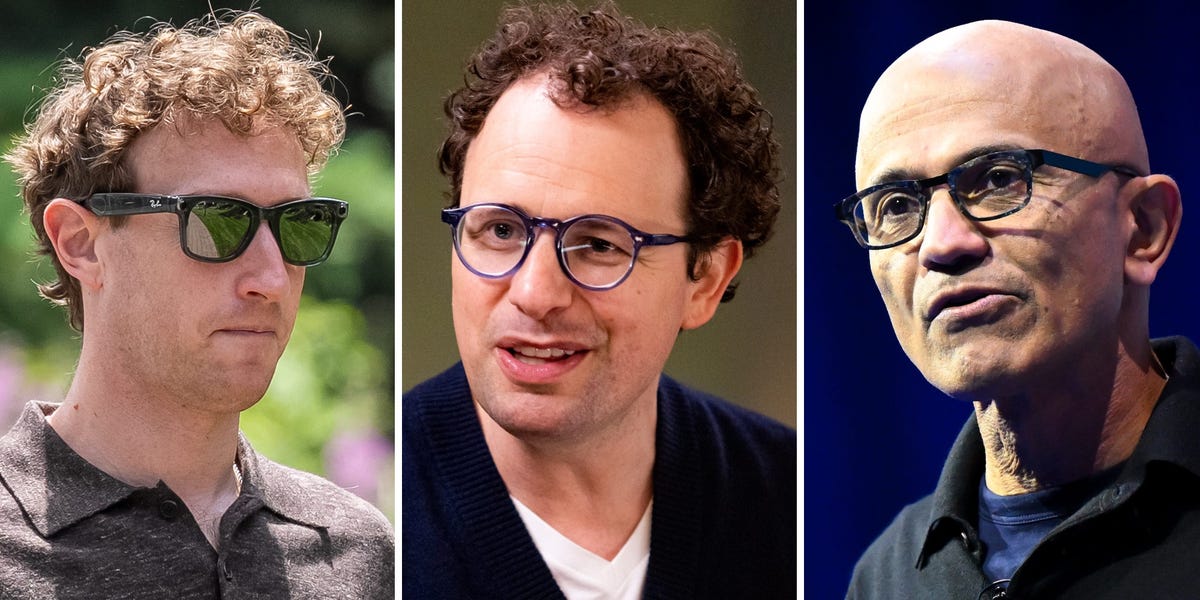
Mark Zuckerberg is often sparing with his words. On Monday, he published over 6,000 of them.
Executives from the leading AI companies keep writing long, long manifestos. Anthropic CEO Dario Amodei is the biggest player in lengthy essay-writing. His “Machines of Loving Grace” — which clocks in at over 13,000 words — has been printed, bound, and given out as merch.
Meanwhile, Microsoft CEO Satya Nadella has taken to posting long essays this year about the AI economy, and OpenAI CEO Sam Altman writes blog posts about the future. Maybe the only abstainer is Elon Musk, who seems to prefer shorter posts and replies on X.
The CEOs’ trend toward wordiness is a bit ironic. Americans are reading less for pleasure, while social video platforms like TikTok soar. AI could be accelerating this change; one wonders how many people have asked Claude for a quick summary of an Amodei essay.
It’s unlikely that much of the American public is sitting down with thousands of words from an AI CEO. So, what’s the point?
“They become these long treatises that you’re nailing to the church door,” said Patrick Riccards, a strategic communications advisor and CEO of Driving Force Institute. “The heft of their message carries a gravitas.”
In AI, writing is all the rage
Zuckerberg’s essay charted a “path to a positive AI future.” It’s a common trope for these companies’ leaders: prophesying how AI will rise.
Amodei’s classic 2024 essay has a similar subtitle: “How AI could transform the world for the better.” While Zuckerberg narrows in on the economy and government, Amodei spends more time with biology and neuroscience. The essay has since been printed as a book and resold on eBay.
Nadella and Demis Hassabis, Google DeepMind’s former CEO who recently announced his transition to chair of the AI lab, use their X essays to ask big questions. In his much-praised post, Hassabis proposed a self-regulatory “Standards Body.”
Then there’s Altman, who seems to have backed off his philosophical blogging. He once wrote long posts about the singularity and AI economics; now, his posts are often product updates or reflections on his family’s life.
While Altman has slowed his own lengthier writing, he has criticized the words of his rivals. He used one blog to link a critical story in The New Yorker to a Molotov cocktail attack on his home.
“Words have power,” Altman wrote. “I am awake in the middle of the night and pissed, and thinking that I have underestimated the power of words and narratives.”
What’s with the writing craze? Riccards said that it was about creating an ideological paper trail, one that the CEOs can cite down the line. He also pointed to control: “You own every word of it.”
Melissa Swift, founder of the organizational consulting firm Anthrome Insight, said that these CEOs have “very pure” impulses: they want to be understood. But that’s not always the effect, she said.
“The longer a document you put on the page with your unfiltered thoughts, the more likely it is to be misunderstood,” she said.
Is anyone reading these essays?
Attention spans are fracturing, and many Americans are more inclined to scroll Reels than pick up a book. (Zuckerberg should know this, as he also runs Instagram.) So, does anyone actually read these manifestos?
Riccards gave a quick “no.” Maybe they’re read by the labs’ competitors or the venture capitalists, he said. “I’m surprised you don’t see more of these CEOs doing this as a video,” he said.
Swift pushed back against the video impulse, saying that they often look “heavily edited” or “like a hostage video.”
She gave two readership demographics: the media (you’re welcome!), and the tech superfans. The problem, Swift said, was that the superfans were within the same “Silicon Valley echo chamber” as the CEOs.
“The superfans are clapping with each one, but the rest of the country — both geographically and by each industry — have a different reaction,” she said.
Read the full article here