




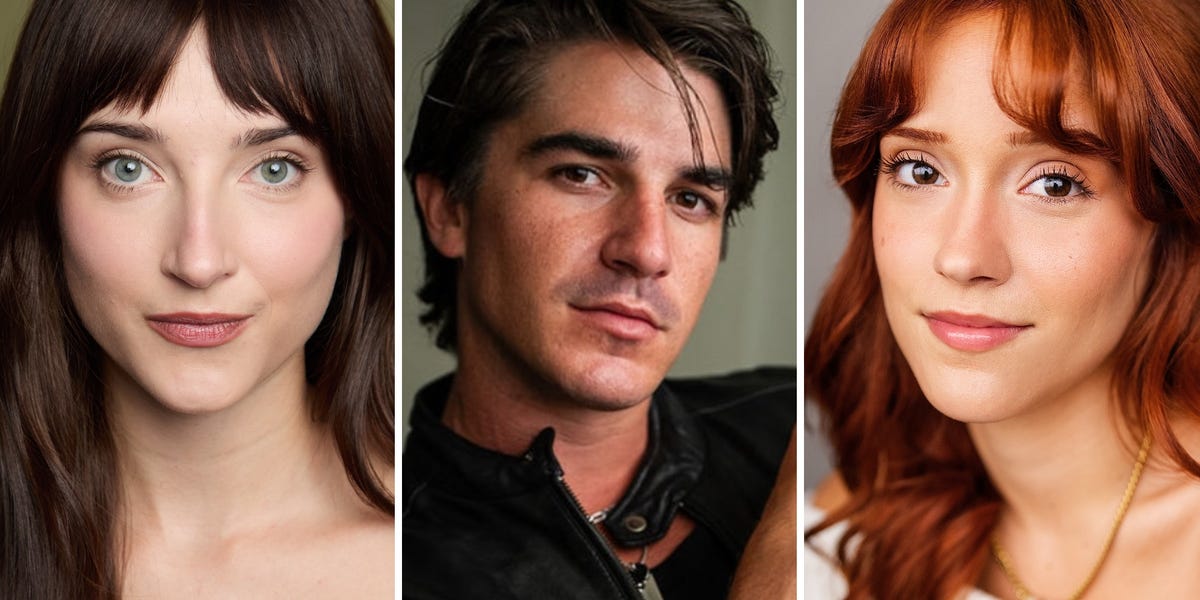
An ad for the micro drama “How to Tame a Silver Fox,” an age-gap romance, opens with a shot of a woman, then cuts to two people having sex.
The promo for the ReelShort show was a shock to Tess Dinerstein, the woman in the scene. The reason: There wasn’t any sex or nudity in the show itself.
“It was really jarring,” Dinerstein told Business Insider. Dinerstein said she worries that people won’t take her seriously as an actor if they see the promo. She also worries about how her parents could react.
“I felt like it delegitimized the work I do,” she said. “I’m so grateful to be an actor, but I don’t take my clothes off. Nothing against people who do, but I don’t.”
Dinerstein has become a prominent actor in the world of micro dramas, also called verticals or mini dramas. These soapy series have short episodes — often one to two minutes — and are made for mobile viewing. They’re on the rise in the US: Deloitte predicted that revenue made by micro drama apps would more than double this year to $7.8 billion, with the US accounting for nearly half of that.
The apps, many of which originated in Asia, are fighting tooth and nail for US market share. Industry insiders say the marketing costs to attract new users are sky-high, which incentivizes companies to make promos as eye-catching as possible.
“An app may boast of a show that makes $30 million, but $27 million of it will have gone to advertising,” Thom Woodley, a longtime verticals producer, recently told Business Insider.
In the quest for new viewers, some apps are angering their actors — including Dinerstein — by creating misleading, sexualized promos to lure people to their shows. Three actors said when they complained to the apps, they were told the ads were made by third parties.
‘Not everyone knows I didn’t agree to do that’
Actor Faith Orta said she was “flabbergasted” to see an ad pop up on her TikTok feed that showed a man pulling off her top and grabbing her breast, which was blurred.
“In the real scene, he never even grabbed my breast,” she said. “I’m very body positive, and I’m all about consent. When AI jumps in and shows the audience something I don’t want to show, it takes away the power over my own body.”
AI has made it easy to create fake videos that look real, and actors say these sexualized ads can have emotional, reputational, and financial consequences.
David Eves said he was caught off guard when someone sent him an ad for a vertical he was in, “Turn the Mafia’s Virgin Wife On,” that showed his likeness in a threesome. Eves said he never shot a threesome and wouldn’t have consented to such a scene.
“Not everyone knows I didn’t agree to do that,” he said.
Actor Haley Lohrli said she started getting creepy messages from fans after a series of ads for a film she starred in circulated. The ad showed her in a bra and underwear, though she was fully clothed in the film. When she contacted the app that distributed the film, she was told there were some 300 variations of the ad out there, she said.
“It feels so gross to see videos of yourself that’s not even you,” she said.
Vertical actors are sharing their stories on social media and urging others to include contract clauses requiring consent for AI manipulation of their image or voice.
Lohrli said she now insists on language in her contracts that protects her likeness from AI manipulation. Lohrli said she’s worked with multiple producers since then and hasn’t gotten any pushback on the contract language.
The experiences of these micro drama actors are part of a larger threat the profession faces as AI makes synthetic videos increasingly realistic and cheap to create. Actors are taking steps — such as trademarking themselves — to protect against AI video generators using their likenesses. The actors’ union SAG-AFTRA struck an agreement with the major Hollywood studios in 2023 that included a ban on the use of digital replicas without consent, and is seeking stronger AI protections in this year’s contract negotiations with the studios and streamers. The two sides reached a tentative agreement on May 2.
Actors have little recourse
Eves said he figured contacting Anyreel, the platform where the ad for “Turn the Mafia’s Virgin Wife On” appeared, would be a waste of time. He plans to ensure his next contract has AI protections.
Dinerstein said she reached out to ReelShort’s CEO about the “How to Tame a Silver Fox” ad. She said the company told her the ad was created by “the Beijing team” and then took it down.
Anyreel and ReelShort didn’t respond to multiple requests for comment.
Jonathan Handel, an entertainment lawyer, said a standard actor contract generally gives the producer broad rights to use the performer’s image and voice. Overall, cases of actors successfully fighting producers over the use of their likeness are rare for that reason, he said. Actors can seek contractual restrictions that prevent their image from being sexualized for promotional purposes, though that might prompt the producer to hire a different performer.
“It’s about the leverage,” he said. “That’s the brutal reality.”
Actors’ contracts are often signed with a show’s producer, who then sells the film to an app. It’s the app that promotes the vertical on social media. And micro drama actors are largely early-career and nonunion, making it potentially risky to speak up.
Lindsay Lieberman, a lawyer specializing in cyber sexual misconduct, said many states have laws addressing the nonconsensual distribution of intimate images, and a growing number are expanding those laws to cover AI-generated or digitally altered sexual content. Whether those laws apply in a given case would depend on the scope of consent in any underlying contract. She said pursuing overseas companies is often impractical.
Tech companies play a part
Meta and TikTok also play a role. Apps use the platforms to promote and distribute their titles.
Meta and TikTok prohibit sexual activity or nudity in ads and organic content and have policies requiring labels for AI-generated content. Some content slips past those controls, reports have found. A 2026 report by The Verge identified AI ads that appeared on TikTok without disclosures, and a 2025 research report found Meta-owned Facebook and Instagram distributed thousands of porn images, including AI-generated ones. A Meta spokesperson said the company removed the violating content that was shared with them.
TikTok said it’s helped label 1.3 billion videos and has created resources to educate people on spotting deepfakes. A Meta rep said the company is continuously working to improve its AI labeling, and added that identifying such content can be challenging.
Dinerstein said she worries about how the AI technology will be used next.
In January, she saw an ad for a new project of hers, “High School Diary,” that had her saying something about being a virgin that she didn’t say in the movie.
“That was obviously not as scary as having deepfake porn made, but it’s sexual in nature,” she said. “If they can make me say that, they can make me say anything. And if I don’t throw a fit over this, who knows how far they’ll take it?”
Read the full article here