




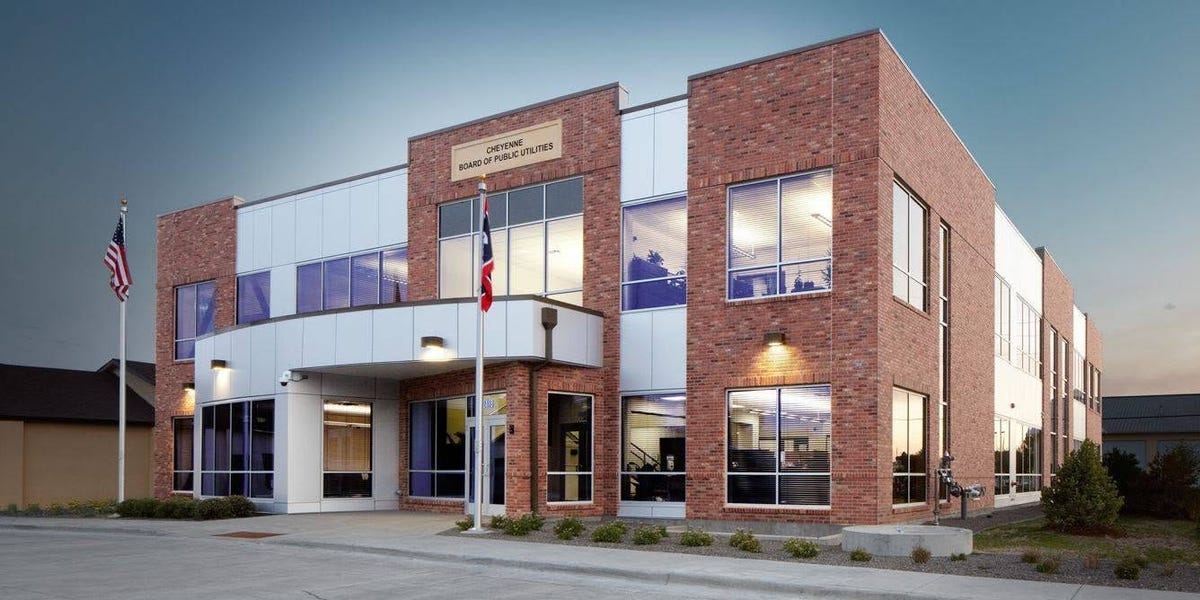
Officials in the city of Cheyenne, Wyoming, say a massive, under-construction Meta data center campus located just south of the city is responsible for contaminating part of its recycled water system.
Cheyenne’s Board of Public Utilities said in recent public notices that water discharged by Goat Systems, a Meta contractor at the site, contaminated the city’s wastewater treatment facility with a rare bacterium.
That facility includes Cheyenne’s reuse water system, which is used for irrigation purposes only, a board spokesperson said. The system cleans used water so it can be safely released back into the environment or reused for watering things like parks and golf courses. The bacterium did not enter the city’s drinking supply, city officials said.
“We were able to connect the Meta Data Center campus to this through sampling their site and it was determined to be through their fill-and-flush discharge that the bacteria was introduced to the system,” Erin Lamb, a spokesperson for the Board of Public Utilities, told Business Insider on Tuesday.
Fill-and-flush operations are a cooling system for data centers in which water is periodically flushed from pipes, discarded, and then replenished with new water. Some data centers now use a “closed-loop” system that recycles the same water within the facility.
The board’s public notice characterized the infraction as “significant noncompliance” and revoked Goat Systems’ “industrial discharge privileges for fill and flush operations.” While the board posted the notice on July 2, it said the operations were halted on March 24.
Goat Systems, the Meta contractor, “immediately ceased discharge of wastewater from the fill and flush operation” after it was notified of the pollutant, Cheyenne’s Board of Public Utilities said. A representative for Goat Systems could not be reached for comment by Business Insider.
A Meta spokesperson told Business Insider the company is working with its general contractor, Fortis, to resolve the issue.
“When the board shared that it found a substance in the city’s wastewater — not public drinking water — Fortis immediately stopped discharging industrial wastewater and began hauling it offsite,” the spokesperson said. “Fortis also began its own water testing with an independent environmental specialist, which has found no trace of the substance.”
A spokesperson for Fortis said the company “takes its environmental obligations seriously and will continue to work constructively with BOPU and all relevant authorities as this matter is fully resolved.”
The Cheyenne Board of Public Utilities said in its notice that it would pause accepting any industrial water discharge from any data center, whether it’s a fill-and-flush or closed-loop system.
The board said the bacterium it found in the wastewater was Cupriavidus gilardii. Although infections are rare, direct exposure can pose a risk to older people or those who are immunocompromised. Laboratory staff identified the bacterium during a wastewater sampling in February, the board said.
“Over the past two months, BOPU staff have undertaken significant remediation efforts, including draining and disinfecting the entire reuse water system and Prairie View Pond to eliminate any remaining bacterial presence,” the board said in its notice. “To prevent potential migration throughout the reuse distribution network, all affected irrigation systems were temporarily converted to potable water supplies.”
Lamb, the spokesperson for BOPU, told Business Insider that the agency plans to hold a press conference on the matter in the next week or so.
Meta announced the $800 million, 715,000-square-foot data center development in 2024. Once the campus is fully operational, Meta says it will be wholly sustainable. The company said it aims to be water-positive by 2030, meaning it will restore more water than it consumes.
“The Cheyenne Data Center will be optimized for our AI workloads and help people connect, build communities, and grow their businesses,” Meta said at the time of its announcement.
Data centers have become a divisive topic. Tech companies are spending billions of dollars to develop the facilities that power their AI products. They say data centers can generate economic growth, create jobs, and push the US ahead in the AI race against China.
Critics, however, are much less enthused. Many Americans are pushing back against data centers and don’t want them anywhere near their communities. They’re concerned that the sprawling facilities will negatively impact water resources, worsen air quality, increase noise levels, and interfere with their quality of life. Some protesters have swarmed local planning meetings, created petitions, and taken legal action to stop construction.
In response, a handful of legislators have taken steps to place parameters around data center developments or ban them altogether. At the federal level, Sens. Bernie Sanders of Vermont and Alexandria Ocasio-Cortez of New York proposed a moratorium on AI data centers.
The data center industry is still speeding full steam ahead, however. By the end of 2025, there were over 1,400 data centers built or approved for construction in 45 states and Washington, DC.
Read the full article here