





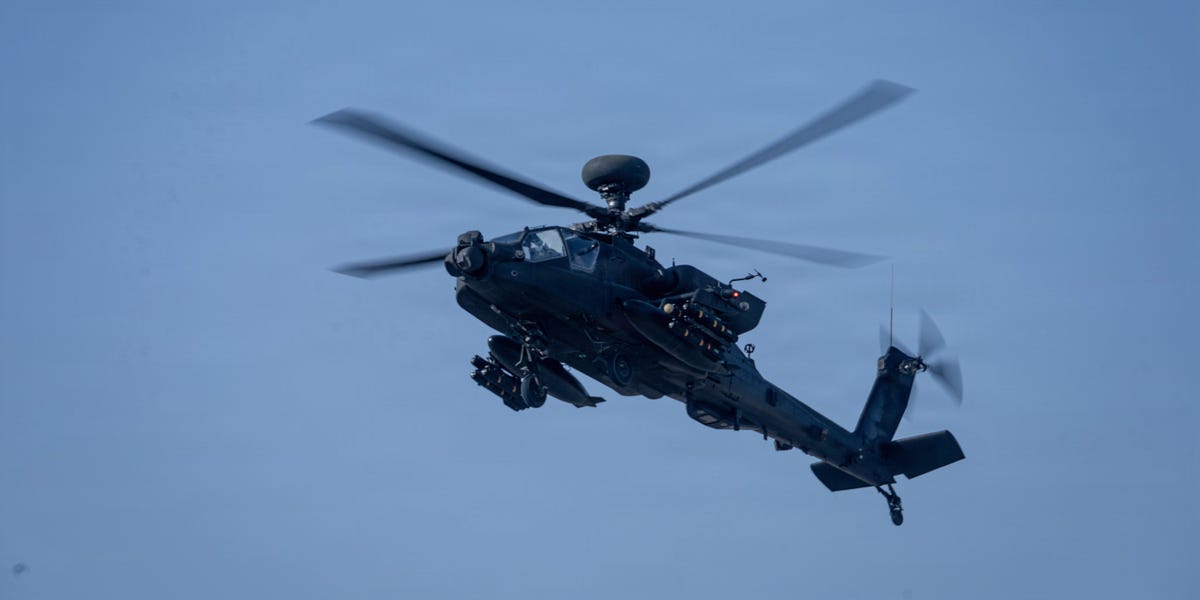
A US Navy surface drone found and rescued two American soldiers after their Apache helicopter crashed off the coast of Oman, a military official confirmed on Tuesday.
The drone’s participation in the rescue mission appears to be a first for the US military and comes amid a broader Pentagon push to integrate uncrewed systems into operations.
US Central Command, which oversees American military operations in the Middle East, said US forces rescued two US Army AH-64 Apache crew members early Tuesday morning local time after their helicopter crashed while patrolling regional waters.
The soldiers were rescued within roughly two hours and are in stable condition, CENTCOM said, adding that the cause of the crash is under investigation.
CENTCOM said rescue efforts were led, in part, by the Army’s 82nd Airborne Division, an elite conventional infantry division that specializes in parachute-assault operations and rapid crisis response.
Thousands of soldiers from the 82nd deployed to the Middle East earlier in Operation Epic Fury, which began at the end of February, as the Trump administration weighed sending troops to conduct ground operations in Iran. However, their role in the conflict has been unclear in the weeks since.
CENTCOM said the Apache rescue mission was also supported by the US Air Force and US Navy, including the latter’s Task Force 59, a Middle East-based unit focused on integrating drones and artificial intelligence into maritime missions.
A CENTCOM spokesperson told Business Insider that a Task Force 59 surface drone located and rescued the Apache crew.
The US military has lost dozens of aircraft — including fighter jets, refueling tankers, helicopters, and combat drones — in the Middle East since the start of the Iran war; however, this crash marks the first Apache loss in the region since it began.
These attack helicopters, flown by the American military and several US allies, can be armed with AGM-114 Hellfire missiles and have been used to target Iranian small boats around the Strait of Hormuz.
The crash comes amid a fragile, monthslong ceasefire between the US and Iran. The two sides have repeatedly traded fire in recent days, despite President Donald Trump insisting that a deal is near.
On Friday, for instance, the US military said it carried out strikes on Iranian radar sites after intercepting Iranian ballistic missiles and drones launched toward the Strait of Hormuz and Gulf states. And on Monday, Israel and Iran traded strikes, further testing the ceasefire.
Read the full article here