






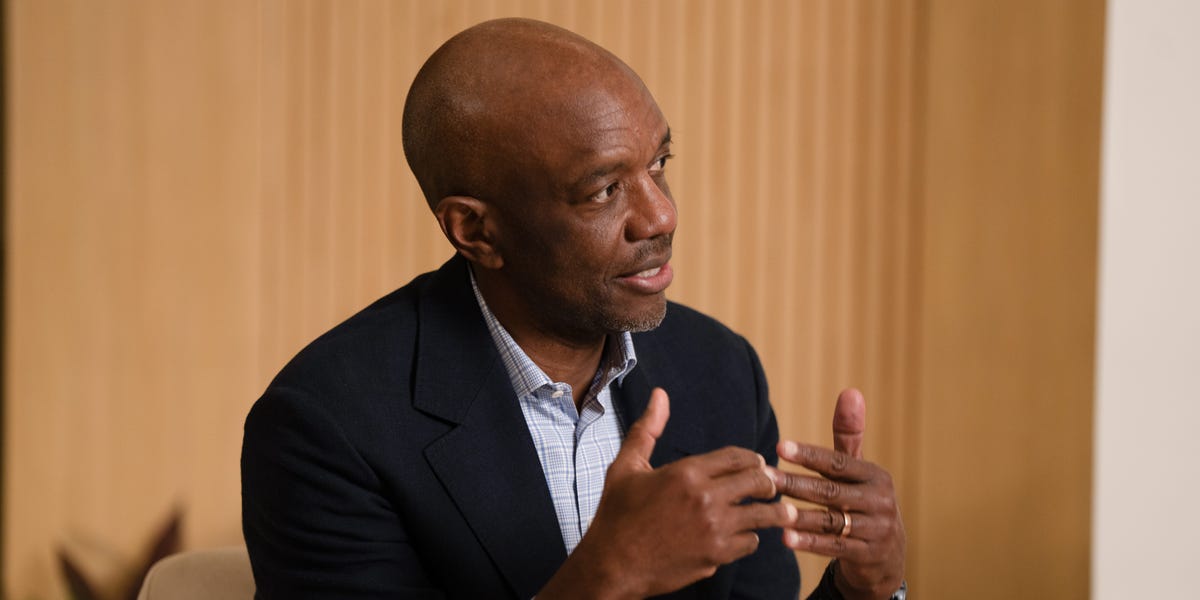
Will AI crush the jobs economy? James Manyika, a senior Google-Alphabet executive, bets it won’t.
On Casey Newton’s “Platformer,” released on Tuesday, Manyika said he does not buy the most extreme predictions about near-term mass job loss from AI.
Newton asked Manyika about Anthropic CEO, Dario Amodei, predicting that unemployment is about to spike because of new tech.
“I’ll just say: let’s take the bet,” he replied. “Some of those predictions were made two years ago — that in two years, 50% of jobs would be wiped out. Well, two years is up. Let’s take a look. And anybody who makes that prediction for two years from now, I’m willing to take the bet.”
Manyika has a deep background in AI research. He has a Ph.D. in AI and robotics from Oxford, co-chaired the UN Secretary-General’s AI advisory body, and has served as chairman of the McKinsey Global Institute while studying automation and the future of work. He’s now a senior vice president at Google and Alphabet, where he focuses on research, technology, and society.
In 2017, he coauthored a widely cited McKinsey report titled “Jobs lost, jobs gained,” which argued that automation would produce a mix of effects on workers: some jobs would decline, some new jobs would be created, and many more existing jobs would change.
Manyika said that the framework is still accurate.
“The research hasn’t changed very much,” he said. “The debate that people have is, what’s the mix of those three things? As opposed to, are these three things going to happen?”
Public skepticism toward AI is growing. In early May, YouGov published a poll finding that seven in 10 Americans believe that AI is advancing “too fast.” Gallup also found that seven in 10 Americans opposed local construction of the data centers that fuel AI systems.
Those concerns are showing up in public life: some college graduates have booed commencement speakers who talk about AI, while several data center projects have sparked protests.
Manyika suggested the AI industry has contributed to public anxiety by talking about mass job losses, and said companies also need to show that AI infrastructure will not raise energy costs for communities.
“It doesn’t help when we in the AI field talk about wiping out 50% of jobs,” he said. “We’re probably impacting the possibilities of this technology having extraordinary impact by, quite frankly, scaring everybody — when in fact that fear is unfounded.”
He joins a growing number of tech executives pushing back on predictions of mass AI job losses.
Palo Alto Networks’ CEO, Nikesh Arora, called concerns that AI is supplanting jobs a “fallacy,” while Amazon Web Services’ CEO, Matt Garman, said his company is still planning to hire 11,000 software engineering employees this year.
Silicon Valley has gone through a fresh wave of job losses. Layoff-tracking firm Challenger, Gray & Christmas reported that through April, tech companies have announced 85,411 layoffs, a 33% increase from the same period last year.
“That’s not to say we shouldn’t worry about AI’s labor market effects. We should,” Manyika said. “I just don’t think they’ve happened yet at the scale anybody’s concerned about.”
Manyika maintains that AI’s largest impact will be on how workers complete their tasks.
“The biggest effect is the jobs-changed part,” Manyika added. “The nature of the job itself shifts. This is what happened with bank tellers. This is what happens with radiologists. We still have the category ‘bank teller,’ but I can guarantee what a bank teller does today is not what a bank teller in 1970 did.”
Google didn’t immediately respond to a request for comment from Business Insider.
Read the full article here