






In 2026, the affordability crisis is touching every aspect of daily life. At the grocery store, inflation has driven up the costs of products like beef, while people around the world have been feeling the strain of the war in Iran at the gas pump and in other parts of their lives.
People are struggling with the cost of living when it comes to housing, too. Business Insider’s James Rodriguez recently reported on the “new homeowner penalty” in the US, a phenomenon in which new homeowners are paying a larger share of their income on housing than previous generations.
From 2019 to 2024, the average household income in the US grew by less than 1%, while the average down payment on a home increased by 30%.
Economic hardships like these are being felt around the world, leaving many people in some countries with no choice but to rent uncomfortably small living arrangements.
For others, building new tiny homes has become a way to combat rising costs and social issues such as homelessness. While nonprofit organizations are constructing affordable micro-apartments, some architects and designers are creating their own tiny homes for personal use.
From New York to Hong Kong, see people’s tiny living spaces in photos.
Small living spaces known as “coffin homes,” “mosquito units,” and “cage beds” are found around the world.
As the global population increases and the number of renters is on the rise, some cities such as Hong Kong and San Francisco have seen a surge in the construction of tiny, more affordable homes and apartments.
Some units are smaller than 200 square feet, earning them nicknames like “coffin homes,” “mosquito units” and “gnat flats,” the Associated Press reported.
Some living quarters are even smaller, like Hong Kong’s 14-square-foot cage-bed cubicles, which have existed for decades, the South China Morning Post reported. They typically fit a bed and hooks to hang personal items, and residents share a bathroom and kitchen.
Hong Kong has gained the reputation of having some of the smallest and most costly apartments in the world.
Some apartments in Hong Kong are smaller than parking spaces but cost almost half as much as an average home in the city, according to a 2021 Bloomberg report.
“Coffin homes” are named after their small size and little free space. Rent prices vary on these types of homes, but as of 2026, some residents still pay under $400 in US dollars, the South China Morning Post reported.
Despite the city’s housing hardships, recent data indicates a housing boom is emerging in Hong Kong, Bloomberg reported.
Some city residents pay a third of their salaries for micro apartments.
This 193-square-foot flat in Hong Kong is considered a micro-sized upscale apartment, according to The Associated Press.
“Every time that I step back into this (apartment) I kind of feel like a cat squeezed into a box,” Donny Chan, an art director at a medical equipment maker at the time, told The Associated Press in 2017, when he lived in the home.
At the time, Chan paid $1,300 a month, about a third of his monthly salary, for the apartment. Critics of micro apartments say the small living spaces are widening inequality and promoting unfair living conditions.
Thousands of residents in Hong Kong live in shoebox-sized apartments that aren’t even designed to house people.
Some residents can’t even stretch out their legs while sleeping in the tiny apartments in Hong Kong, The Associated Press reported.
An estimated 200,000 to 220,000 Hong Kong residents live in coffin homes, according to India’s NDTV.
Landlords in Hong Kong have also created “cubicle flats” by carving out individual living spaces from a single apartment.
The homeowner of this “cubicle flat” managed to fit a shrine, fridge, and bed into his tiny space.
Some landlords partition 400-square-foot apartments into 20 double-decker, 15-square-foot “coffins,” The Guardian reported.
Unique tiny home concepts have emerged in Hong Kong, such as the OPod tube home, which is built out of a giant drainage pipe.
The idea behind the OPod tube house is to create affordable housing inside giant concrete drainage pipes, which can be stacked, according to architect James Law.
Law designed the 100-square-foot tiny house around the pipe’s circular design. Each home would cost $15,000, but Law said he hoped the cost of renting one would be no more than $400 a month.
The OPod homes have yet to be rolled out on a large-scale.
In Tokyo, some young adults have chosen to live in affordable tiny apartments so they can spend their money in other ways.
Like Hong Kong, micro-apartments in Tokyo can be rented for under $400, The Guardian reported in 2023.
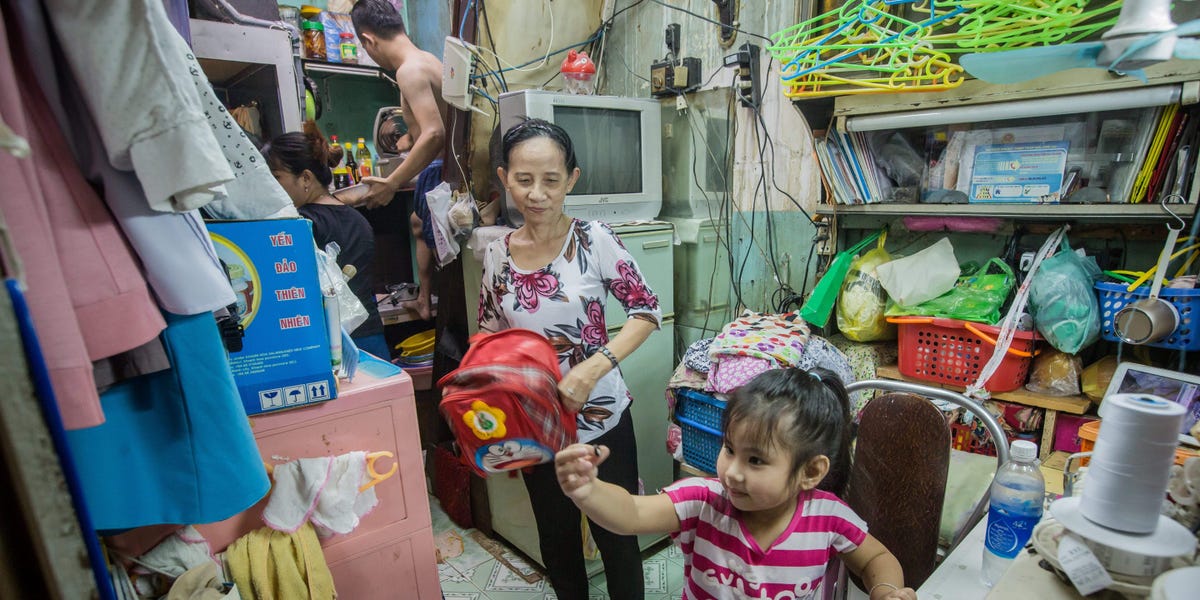
Tiny apartments in Ho Chi Minh City, Vietnam, are tucked between alleys, food stalls, shops, and houses.
Often, tourists and civilians completely miss these spaces because of how small they are, the Agence France-Presse reported.
Some students in Shanghai live in cheap, cramped apartments while studying for their graduate entrance exams.
The cramped conditions are ideally viewed as temporary before the residents get into graduate school.
Unable to afford the city’s housing costs, Beijing resident Dai Haifei designed and built an egg-shaped house on the sidewalk.
Reuters reported that Dai Haifei made the home out of bamboo strips, steel bars, and waterproof materials in 2010. For months, he lived in the structure near his office in Beijing.
The 6.5-foot-tall pod cost him $964 to build at the time, per China Daily. Local authorities ultimately deemed the structure illegal, and he was ordered to remove it.
Residents of Brazil’s favelas live in small, cramped conditions.
The BBC reported in 2023 that residents in the Paraisópolis favela — an impoverished neighborhood — lived with mold growing on the walls in conditions barely large enough to fit a double bed.
At the time, one resident paid $73 per month for such a space.
In São Paulo, micro-homes are helping to address the issue of homelessness.
Brazil’s first village of micro-houses was built in 2022 in the neighborhood of Canindé, featuring houses just under 200 square feet, the BBC reported.
A lack of affordable housing has pushed some people out of their homes and into their cars.
Jeff Slocum, who lives in the US, lived out of his 2005 Chrysler Town and Country van for years.
After a neighborly dispute forced him out of his living situation, he moved into his van in Upstate New York. Slocum told Business Insider in 2021 that, while he had faced many challenges since his car lacked a bathroom, kitchen, or heater, he still persevered.
“If you take a deep breath, slow down, think creatively, and [do one] task at a time, you can survive,” Slocum said.
Some people have converted shipping containers into houses for a fraction of the cost of building a more traditional home.
Both individuals and companies are turning recycled, steel shipping containers into tiny homes.
Amid a housing shortage, students at a university in Kiel, Germany, and a local welfare organization converted shipping containers into homes.
In 2021, two containers were converted into tiny homes for students and people experiencing homelessness in Kiel, Germany.
According to Kiel University’s International Center, affordable housing is difficult to find in the northern German city.
About 1,000 students were on a dormitory waiting list in 2021, Die Tageszeitung reported. At the time, the two container houses were rented for about $320 a month.
A tiny home designed by architecture students in Berlin utilizes every inch of space, with built-in shelving and storage units.
Van Bo Le-Mentzel, who founded the nonprofit Tinyhouse University to identify ways to tackle housing issues, told Bild he wants everyone to have affordable housing.
In 2017, Sarah Ullmayer and Sophie Kany, pictured, lived in a tiny home on a campus devised by Tinyhouse University. The students designed the home themselves in response to limited living space in the area, leaning into a minimalist style where everything is meant to be easily hidden, including the bathroom.
In the US, some tiny-home villages in California are trying to combat the issue of homelessness.
In 2024, homelessness in California hit record highs, accounting for nearly 25% of homeless individuals in the US, per the Public Policy Institute of California. Some people are looking to tiny homes as a potential solution.
In October 2021, one of the country’s largest tiny home villages opened in Los Angeles. The Arroyo Seco Tiny Home Village, designed for people experiencing homelessness, has 117 units and 224 non-congregate beds for people, with each unit being 64 square feet.
One organization is attempting to showcase how micro-homes could help solve the affordable housing crisis.
The Healthy Housing Foundation, a nonprofit organization that attempts to combat homelessness and the high cost of living, installed a 352-square-foot model micro home in Downtown Los Angeles in 2018.
As of 2024, the organization has purchased and renovated 15 properties in the city. A single home can house five people and costs $89,000 per unit.
The Miracle Terrace Building in Anaheim, California, houses low-income elderly residents in tiny studio apartments.
The roughly 450-square-foot apartments house nearly 200 low-income elderly residents, the majority of whom are Korean, The Los Angeles Times reported in 2014.
In Los Angeles, where space is at a premium, contractors attempt to make compact spaces feel more open.
Todd Segal, a contractor, completely refitted the family’s 625-square-foot home in Highland Park, California, The Los Angeles Times reported. Barely bigger than a one-bedroom apartment, it has a bedroom, a bathroom, an open living-dining-kitchen area, and a tiny loft for his 14-year-old daughter.
In Seattle, compact apartments appeal to a few key demographics.
Many units in Seattle were designed to appeal to students, retirees looking to downsize, and other groups. Some apartments in the city’s First Hill neighborhood are about the same size as a large parking spot, The Associated Press reported.
Micro apartments in Seattle usually come with a private bathroom and built-in furniture.
The resident of this 200-square-foot apartment said this was an affordable way to live inside the city center for under $1,200, Reuters reported in 2013.
In 2026, many apartments are still offered in the neighborhood at a similar price range.
A ski resort in one of the US’s most expensive ski towns built tiny homes for its seasonal workers.
In Aspen, Colorado, the ski resort Aspen Snowmass ran out of affordable housing for its seasonal workers, who are employed to run the town’s ski slopes and restaurants, prompting the company to build a tiny-house village in 2016.
The company bought six 500-square-foot homes that year for $100,000 each, and added 34 more in 2017.
There’s also been a rising tiny-house movement in Silivri, Turkey, as people look for affordable vacation housing away from bustling city centers.
In Silivri, Turkey, tiny homes saw a resurgence in popularity as people and families searched for affordable vacation rentals in nature during the COVID-19 pandemic, Gulf Today reported in 2021.
The homes are typically between 160 and 430 square feet.
Chris Heijmans and her husband, Rick de Vries, sold their home and moved into a yurt in Riel, Netherlands, to save money during the COVID-19 pandemic.
The couple decided to sell Heijmans’ house in 2020 and live tiny in a yurt — a small, round dwelling — on farmlands in the south of the Netherlands to reduce costs and live more freely.
New York City is another notoriously expensive city with micro-apartments.
In February 2026, the median rent in Manhattan was $5,000 per month, Yahoo Finance reported, citing a 2026 rental market report from the Corcoran Group.
The high rent incentivizes many residents to look to shoebox apartments as a solution.
Many New Yorkers are willing to sacrifice space for solitude.
Alaina Randazzo spent $650 a month in 2022 for this micro-apartment without a bathroom. Located in Midtown Manhattan, it clocks in at just 80 square feet.
Read the full article here