


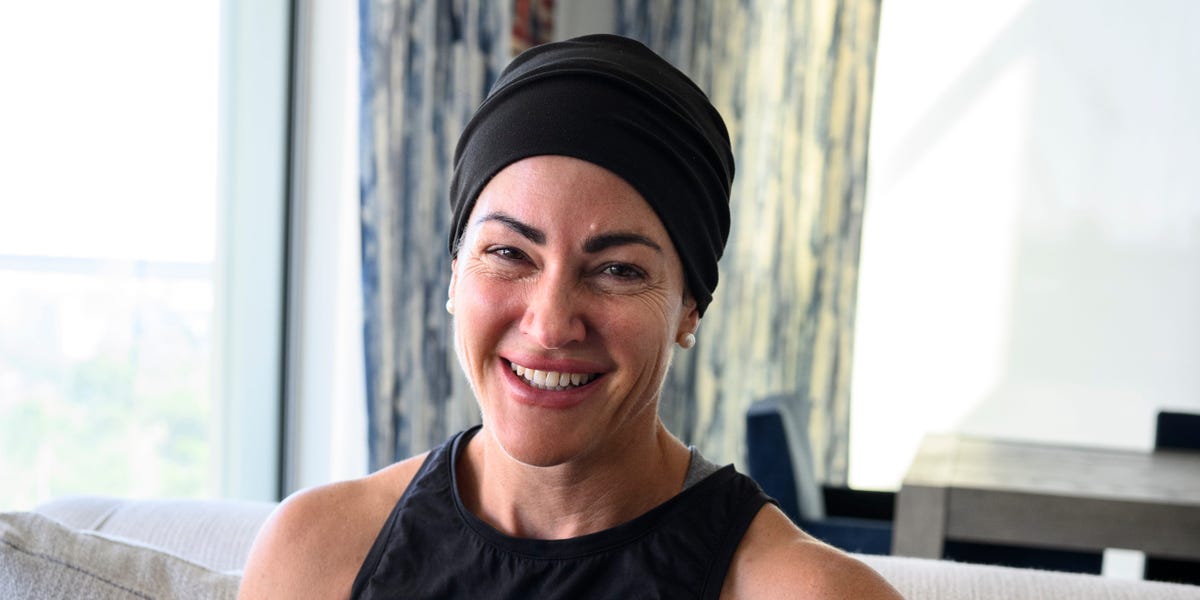
When Jennifer Goldsack woke up after emergency surgery last Christmas, she was waiting to hear she had a stress ulcer. Maybe appendicitis. But not this.
The surgeon had news that made no sense to her, as a 42-year-old CEO and former athlete: late-stage cancer.
Goldsack had always prided herself on being able to get anything done — Olympic training schedules, corporate roadmaps, back-to-back meetings.
Cancer forced her into a new, uncertain kind of leadership: one built on vulnerability, delegation, and uncertainty.
“Good leadership is to be able to be clear and to have a plan,” Goldsack, head of the Digital Medicine Society (DiMe), told Business Insider. “Or, to at least have a plan to make a plan. And I wasn’t able to do that.”
She is sharing her story to highlight the pressures that today’s leaders face, often having to shoulder pain and stress in silence. And to share how she’s learned, over the past 10 months, to lead her organization with more vulnerability than she ever imagined she’d allow.
She dismissed early signs of cancer as personal failures
As a world-class Olympic rower, Goldsack knew how to push her limits. She had perfected the art of identifying her strengths and working effectively as part of a team.
That helped her move seamlessly into leading a company. As a CEO, she prided herself on being the kind of boss who never asks her employees to do more than she would. “Be humble, be hungry, and always be the hardest working person in the room” was her mantra.
The early signs of cancer crept in slowly over time. With the omniscience of hindsight, it’s easy to say Goldsack should have realized something was really wrong last year. In the moment, she just thought she was run down.
She was rejected from giving blood for two months in a row, because her iron levels kept getting lower and lower — too low to help others. She was dealing with stomach pain that was bordering on excruciating.
Through it all, she was telling herself she was a failure. This was her fault. How else to explain it? She’d perfected the art of training hard and recovering smart over many years. Inexplicably, her winning strategy wasn’t cutting it anymore.
“It was almost an affront on how I defined myself as a person because I didn’t know what I was doing wrong,” she said. Her self-talk disintegrated. “You idiot, suck it up, get it together, you need to get better with your sleep.”
She was so tired in a way that a good nap on the couch simply couldn’t fix. Picking at meals, stopping for Pedialyte at the gas station regularly. Was she experiencing the “hot girl IBS” that everyone on the internet was buzzing about? Did she need to start drinking one of those expensive green supplement powders every morning?
How foolish she had been to let the stress of her work get to her like this, she thought. Becoming that sad kind of character who eats girl dinner over the sink each night.
“My self-talk was really poor, that it was my fault,” Goldsack said. “I sort of absorbed pretty aggressive symptoms of a pretty frightening disease and allowed myself to drift until it really was a late-stage diagnosis.”
3 big leadership lessons: clear communication, vulnerability, and a ‘take 5’ attitude
For Goldsack, one of the hardest parts of being a CEO with colon cancer is the endless uncertainty.
Her cancer diagnosis was a crash course in living in the moment — not in the eat-pray-love and meditate way (she hates that stuff) — but because she had to constantly reassess her prognosis day by day. She was out of work for a month in January, living in the hospital.
Unable to eat, she lost 40 pounds, dropping almost a third of her body weight. She felt like a frail little bird. Even walking was exhausting, and she needed help with everything.
As a result, she got better at communicating vulnerability and signposting her own limits for others. Some of the learnings were small, but meaningful; others were radical shifts in the way she delegated her work. Here are three of her biggest lessons:
1. Create clear schedules with calendar blocks
Goldsack uses green to block off anything health-related on her calendar. Chemotherapy appointments and infusions are clearly marked as such on the work calendar, so everyone can see when she’s out and know when she’ll return to her desk. At first, the shift felt radical, but as a leader juggling cancer treatment, it’s been crucial to her workflow.
“I’ve really leaned into using my calendar and being really clear about what I’m up to,” she said. She expects her team to carry on while she’s away, knowing she’ll get to her work when she can. “Really communicating with them early: ‘Look, this is what’s going on with me.'”
She hopes the transparency helps foster more open lines of communication, even as she juggles care. “You don’t have to be my gatekeeper,” she said. “I will be my own gatekeeper.”
2. Radical transparency and consistent communication
She also began to feel more comfortable stepping back, at least sometimes.
On mornings when she felt unwell, she’d tell her team she had to go back to bed or cancel her meetings for the day — something she would have never done before.
“It’s been interesting for me on a leadership journey, but also thinking about what it means to have a healthy workforce, and healthy in every sense,” she said. “Me saying ‘guys, I can’t do it today,’ and I’m giving myself space, and I’m being very transparent about that and hopefully creating an environment where you guys know that you can do this too, and you will be supported.”
It was a kind of vulnerability she’d never experienced before. She asked the chair of the board at her organization if he wanted to “bench” her. He didn’t.
“50% of Jen’s effort is like 150% of a normal person,” DiMe chairman Dan Karlin said. “Together we came to the conclusion that staying engaged while making sure to make time to attend to her treatment and her needs, her physical needs, of course, she needs to do that.”
3. “Take 5” minutes
Back-to-back meetings during cancer treatment quickly became an untenable situation.
So, Goldsack started giving herself five minutes at the top of every call. She starts meetings at :05 and :35 now. Those few extra minutes have been game-changing during treatment. She uses them for grabbing a drink, using the bathroom, closing her eyes for a few minutes, or vomiting. Everyone found them restorative and replenishing, to the extent that “take 5” has become an unofficial company policy.
“That’s now sort of become best practice across the organization,” she said. “People realize it’s actually quite nice when you’re stacked with calls.”
Looking ahead
After a year of cancer, Goldsack’s anxious to get back to normal life. She had a public speaking gig at a major industry conference in Las Vegas in October and has her sights set on more in 2026.
Her treatment course is technically over, but the odds of remission are still high, so she’s being closely monitored, in a kind of cancer limbo.
The good news is that her feet no longer feel like they’re stuck in flippers. Now, she’s able to work out more, regaining her muscles.
She knows she’s lucky. But she’s also frustrated by the time she’s lost.
Working has been such a gift during treatment, she said, to be able to be something other than a cancer patient. And yet the way she works has been forever changed by this year of cancer treatment.
“I always used to think that by being the toughest person, I was leading by example in the best possible way,” she said. “This has been an interesting way for me to think about leadership through a different lens.”
Read the full article here