






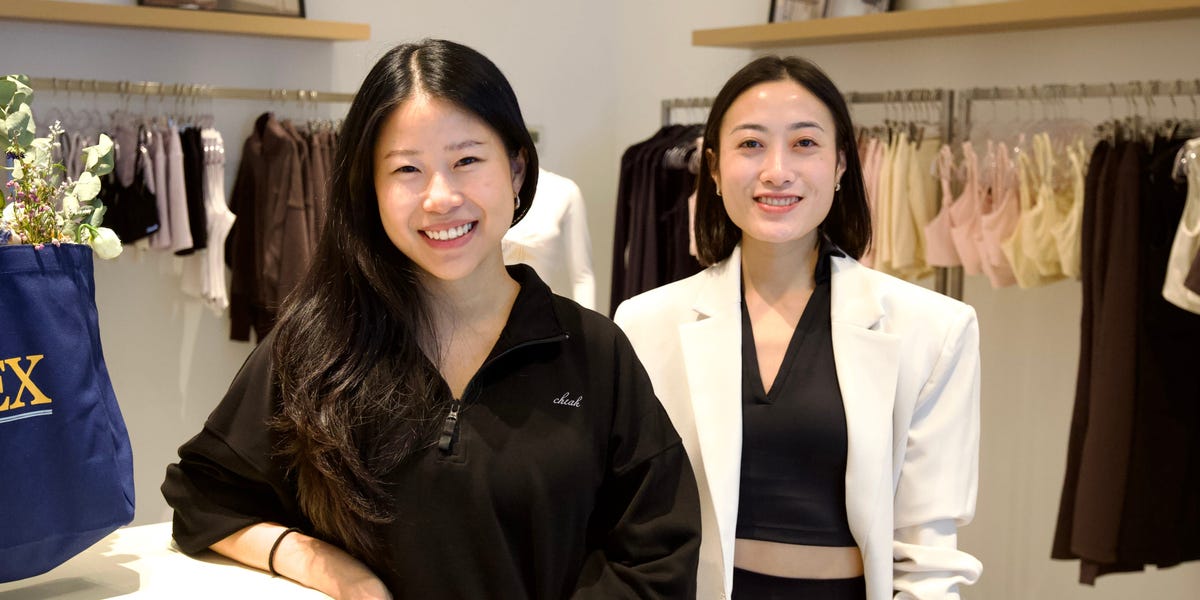
Tiffany Chng and Olivia Yiong said they went from being work besties to regular besties and then work besties again.
The duo, both 31, met in 2018 and became inseparable while working at GuavaPass, a fitness app. Yiong was laid off when Guavapass was acquired by ClassPass in 2019.
Two years later, during the pandemic, Chng was laid off from her marketing job. The duo reunited to launch an athleisure brand, then called Butter, despite having no experience in fashion or entrepreneurship.
Chng’s retrenchment and the pandemic lockdown gave them the push they needed to start the brand.
“At that point, we had nothing to lose,” Yiong said.
They started with online sales, and in October this year, they opened their first retail store in Singapore’s upscale ION Orchard mall, in the heart of the city’s luxury shopping district.
Building a brand during the pandemic in an already saturated market and for a conservative audience was not easy.
Pouring savings and severance pay into the business
Exercise and sports have always been a big part of the founders’ lives.
Yiong was an F45 trainer, has practiced yoga, pilates, and Muay Thai, and is now training for her first Hyrox. Chng was part of a national team representing Singapore at the 2011 Touch Rugby World Cup and has also dabbled in cheerleading, pilates, yoga, and HIIT.
When Chng was laid off from ClassPass in 2020, they decided to go all in on an athleisure clothing line, which started off with the name “Butter.” They invested 20,000 Singapore dollars in 2020 into the brand.
Half came from Yiong’s savings, and the other half came from Chng’s severance pay.
They started product design in March 2020 and found suppliers in China. They launched in October that year with just two products in two colors: a longline sports bra and a pair of leggings.
COVID lockdowns that pushed everyone online helped them gain visibility. About 500 people joined an online workout they hosted in March 2021.
In 2022, they sold the brand to Love, Bonito, a Singaporean women’s wear brand. Afterward, they changed the brand’s name to Cheak.
Making athleisure for Asian modesty
Launching an athleisure brand in Singapore came with a unique set of challenges.
Women in Singapore and Southeast Asia place a high value on modesty and require padding in the bust, the duo said.
“A lot of overseas brands don’t have padding. In Singapore, you need padding; it’s non-negotiable. One of the most commonly asked questions we get is, ‘Does it have padding?'” Chng said.
“But padding changes the construction completely for the product — it requires so many more stitches, and it makes it difficult to have a very clean bind,” she added.
Another issue was the sheerness of the fabric.
“Overseas brands don’t double line their lighter colors because I think the women are a bit more comfortable with a slight sheerness, but in Singapore, that’s not acceptable,” she said.
“But when you double-line a garment, it becomes very thick. So, we spent about a year changing the fabric and reducing its thickness so that when we double-lined it, it would still be comfortable,” Chng added.
Designing clothes for a customer base that likes to play it safe requires a good deal of restraint, the founders said. They said there was plenty they wanted to experiment with, but had to tone down.
“A lot of brands that are quite popular internationally are quite sexy and crazy nowadays,” Yiong said. “So we take that idea, and tweak it to what will work for our audience.”
Standing out from the Lululemons and Alo Yogas of the world
Singapore is becoming a competitive space for athleisure brands. Alo Yoga, the athleisure brand worn by Kendall Jenner and Hailey Bieber, opened its first store in the city’s Marina Bay Sands mall in September.
In ION Orchard, the mall where Cheak is located, shoppers can also find Lululemon, Cotton On Body, and Adidas.
To stand out, Cheak focuses on making clothes for Asian women — and that doesn’t just mean making them more petite.
“The bust shape is different, our waists are smaller, our hips are slightly wider, and the femur is also a little bit shorter,” Yiong said.
Sizing is different for Asian women, too, she added.
“We don’t necessarily grow taller as we get bigger; we grow width-wise,” Yiong said.
She also said that international brands do not suitably cater to the hot and humid climate that Southeast Asia is known for.
“Fresh international brands, let’s say Alo, for example, they come in bringing winter season clothes,” she said. “There’s no winter; we only have one season, so the fabric needs to be cooling.”
Cheak’s prices are slightly lower than those of its foreign competitors. One of Cheak’s bestselling sports bras costs 55 Singapore dollars, or about $42, while a similar-looking piece from Lululemon costs S$58.
Maintaining a friendship while running a business together
The business has yet to come between the founders.
“Outside of work, we don’t talk about work,” Chng said. “We see each other on weekends, and our partners hang out together, but we never talk about work.”
On the flipside, at work, they don’t talk about other things, helping to distinguish their “work personality and friend personality.”
Yiong handles the backend work, while Chng handles the creative and customer-facing parts of the work.
But work and life inevitably collide, like when they go on holiday together and fire up their laptops to solve a crisis.
“Our partners see that as their cue to go do their own thing,” Yiong joked.
Happier with a life away from corporate
Running their business comes with many perks. Chng, who just had a baby, said she loves having a flexible schedule and working in a hybrid setting.
But that doesn’t mean it’s less stressful than a corporate job.
“I think a lot of people glamorize what being a founder or starting your own business is,” she said. “You have to be able to give up everything, your time, your money, your brain power, your emotions into the business because if you don’t do it, no one else is going to.”
She added, “It takes a different kind of resilience to handle it, but at the same time, I wouldn’t trade it for anything.”
Read the full article here