






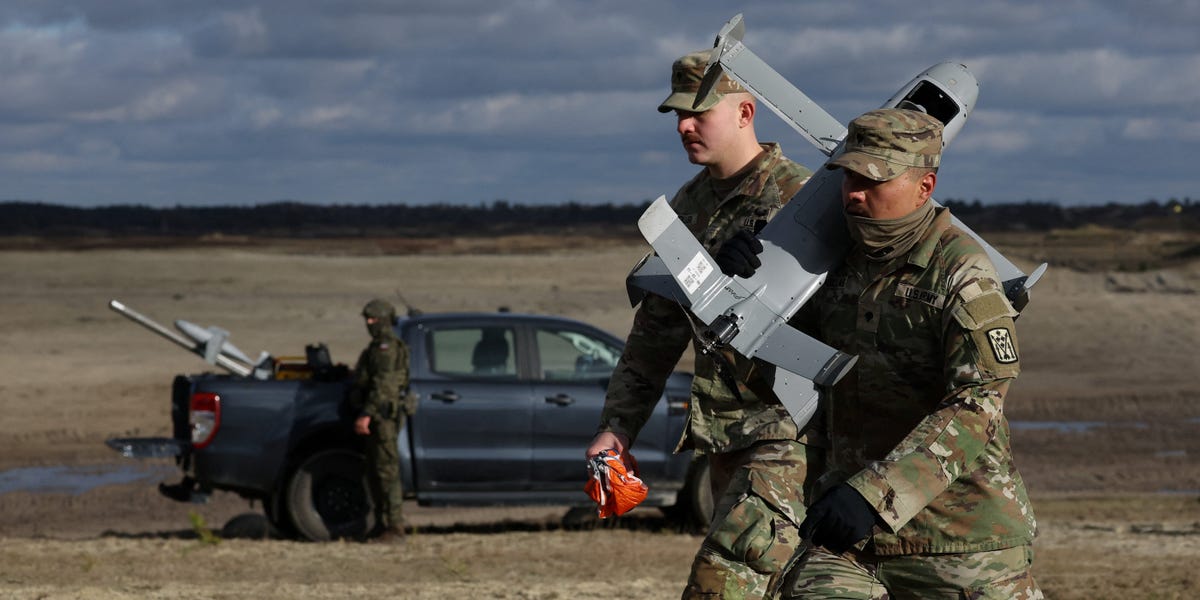
The US Army has set up a massive counter-drone training mission in the Middle East amid the Iran war, surging to the region systems that have extensive combat experience in Ukraine.
A US defense official told Business Insider that the mission marks the Army’s largest-ever counter-drone training deployment. It comes as uncrewed aircraft, which have played a major role in the Iran war, become increasingly prominent on the modern battlefield.
The Army deployed the US-made Merops system, which launches a $15,000 interceptor to take down enemy drones, to the Middle East earlier in the conflict.
Merops is now being operated by US soldiers at two main locations in the region, the defense official said, speaking on the condition of anonymity to discuss military developments. They declined to disclose exactly where the sites are.
At one site, more than 100 US personnel are operating the system and conducting training, with more soldiers cycling through. Roughly 20 Merops complexes — each of which consists of a radar, launcher, ground control station, and interceptors — are deployed to this location.
Soldiers only need a few days to get up to speed on the Merops system. Many of them have a background in air defense, specifically the use of short-range systems like the AN/TWQ-1 Avenger or FIM-92 Stinger, but this experience is not necessary to learn to use the counter-drone technology, the defense official said.
The Merop system can be operated by a small crew. The interceptor drone, called the “Surveyor,” is piloted with a cheap, off-the-shelf Xbox controller that US soldiers have described as easy to use. Business Insider observed NATO forces training on it in Poland last year.
At the other site in a different Middle East country, between 50 and 60 US soldiers are operating around 10 Merops complexes.
The Army has sent 1,000 armed and unarmed interceptors to the two locations, and it is prepared to send more, the defense official said. American forces have not yet used the system to eliminate any Iranian drones, thousands of which have been launched by Tehran at US bases and countries in the Middle East since late February.
A combat-tested system
Merops, developed by the US initiative Project Eagle, is designed to intercept one-way attack drones like the Iranian Shahed.
The propeller-driven Surveyor is a few feet long and can fly at over 175 mph. The weapon destroys targets by colliding with them or exploding in proximity. It uses artificial intelligence to navigate environments heavily saturated with electronic warfare.
The system is designed to be flexible. Launchers can be fitted in the bed of a pickup truck for mobile use or staged at fixed locations.
Merops has been active in Ukraine, where it has intercepted more than 1,000 Shahed-type drones launched by Russia. Last year, several NATO countries in Eastern Europe purchased and deployed the system following multiple Russian drone incursions into allied airspace.
The US deployed Merops to the Middle East in early March after the start of Operation Epic Fury to help protect American forces and regional allies from Iranian drones launched in retaliation.
The deployment gave the US and its allies a cheaper way to intercept Iranian Shaheds, which can cost as little as $20,000, according to estimates, without relying on multimillion-dollar surface-to-air missiles.
Ukraine, which has really pioneered interceptor drone technology and tactics at scale, sent air defense specialists to the Middle East to help deal with the Iranian drone threat, which Kyiv has faced for years.
Ukrainian President Volodymyr Zelenskyy confirmed on Friday that Kyiv has destroyed a number of Iranian Shaheds in multiple Middle East countries. “And in my view, this is a success,” he said.
Read the full article here