




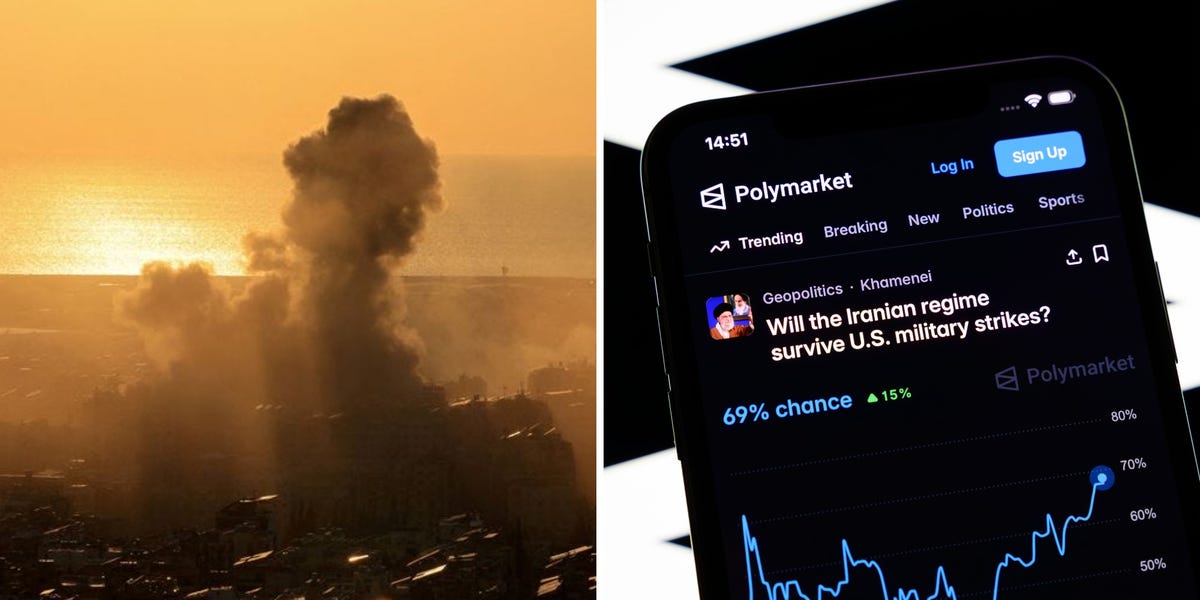
An Israeli journalist said Polymarket users tried to bribe him and threatened to kill him after he reported that an Iranian missile had struck Israel earlier this month.
Polymarket later condemned the harassment and said the conduct violated its rules.
“We’ve banned the accounts for all involved & will pass their info to the relevant authorities,” the company wrote on X.
Emanuel Fabian, a military correspondent for The Times of Israel, wrote this week that the harassment began with emails pressing him to revise a blog post saying a missile hit an area roughly 500 meters from homes in Beit Shemesh, a small city in central Israel.
The initial outreach, written in Hebrew, was polite, Fabian wrote. “Regarding your Times of Israel report that described today’s launch as an ‘impact’ — Beit Shemesh Municipality and MDA (Magen David Adom) later corrected their reports to clarify that what fell was an interceptor fragment, not a full missile,” the first email said, referring to an Israeli emergency-response service.
Follow-up messages from others were more insistent. “I have an urgent request regarding the accuracy of your report on the missile attack on March 10. I would really appreciate a response if possible,” read one.
Fabian wrote that he stood by the reporting, citing Israeli military information and video of a large explosion that, in his view, was inconsistent with interceptor debris.
What followed, he said, was a pressure campaign that spilled across email, X, Discord, WhatsApp, and backchannel outreach through another journalist.
Fabian described repeated requests to change the wording of his report, which he believed was intended to influence the resolution of a Polymarket market tied to whether Iran struck Israel on that date. He said some messages — which didn’t explicitly mention Polymarket, but came from Polymarket users or seemed bizarrely hung up on his blog post — escalated into explicit threats.
“If you do not correct this by 01:00 Israel time today, March 15, you are bringing upon yourself damage you have never imagined you would suffer,” read one.
Fabian wrote that he went to the police and provided evidence.
Polymarklet didn’t answer questions from the Times of Israel about the details of the investigation. Representatives for Polymarket didn’t immediately respond to Business Insider’s request for comment.
Advocates for prediction markets have said they encourage honesty by requiring users to put their money where their mouth is. Shayne Coplan, Polymarket’s founder, has said that people in the Middle East can use military-strike markets to decide whether they want to sleep near a bomb shelter.
The nitty-gritty details of contracts and how they are resolved can lead to contentious arguments. People on Polymarket who wagered on whether Iran would strike Israel by March 10 still haven’t gotten paid, as the contract appears to remain in dispute. Polymarket, which is legally based in Panama, uses a complex, crypto-based process to resolve disagreements.
Fabian isn’t the first person to say they were targeted by prediction market users. The NCAA has cited concerns with prediction markets, reporting that 36% of Division I men’s basketball players said they had been harassed by “someone with a betting interest.”
In January, the organization called for a pause on college sports-related betting prediction market betting until the Commodity Futures Trading Commission, which regulates the platforms, “implements appropriate regulations.”
Polymarket was valued at $9 billion last year and is seeking a $20 billion valuation in talks with investors, The Wall Street Journal reported earlier this month. The company and its competitor, Kalshi, have poured millions of dollars into marketing online, on TV, and in real life, even giving people free groceries in New York City.
The largest chunk of activity on both platforms is betting on sports in a manner that competes with companies like DraftKings, BetMGM, and other traditional sportsbooks. The second-biggest category is speculating on cryptocurrency prices.
Business Insider has previously reported that Polymarket has drawn scrutiny from US lawmakers over concerns about manipulation, insider trading, and the difficulty of investigating crypto-based bets.
Sen. Chris Murphy and Rep. Greg Casar announced Tuesday that they will introduce the “Bets Off Act,” which would ban certain prediction market trades, including terrorism, war, and assassinations.
The attacks on Iran are only one of several geopolitical flashpoints that have been accompanied by concern about the prospect of people with insider information cashing in. One Polymarket user made several hundred thousand dollars correctly betting on the US operation to remove Venezuela’s leader, Nicolas Maduro.
Read the full article here