






NATO has rolled out new “Sentry” missions aimed at strengthening defenses across eastern and northern Europe, even into the Arctic, after years of warnings that its forces haven’t kept pace with modern threats.
These missions, launched over the past 15 months, include new capabilities but also expand or repackage existing NATO operations, from air policing patrols to regional deployments, under a more urgent framework.
The push reflects a growing recognition inside NATO that it has been moving too slowly to address vulnerabilities exposed by Russia’s full-scale invasion of Ukraine.
The missions — also known as enhanced vigilance activities — have largely followed incidents of Russian aggression and other warnings, Ed Arnold, a senior research fellow for European security at the Royal United Services Institute think tank, told Business Insider.
“We might not get another warning,” Arnold said, “so now it’s time to move from a reactive posture to a proactive posture.”
Every time Jake publishes a story, you’ll get an alert straight to your inbox!
Stay connected to Jake and get more of their work as it publishes.
NATO military officials say the missions build on surging efforts to strengthen Europe’s defenses. Vice Adm. Rune Andersen, chief of the Norwegian Joint Headquarters, told Business Insider that “these operational activities are a way of capitalizing on that.”
Business Insider went inside each of the three missions — Baltic Sentry, Eastern Sentry, and Arctic Sentry — as NATO works to close gaps along its borders and prepare for potential conflict.
From surveillance flights near Russia to counter-drone operations on NATO’s eastern flank to war games in the freezing Arctic, the missions show an alliance recognizing the threats and rushing to get ready.
Sabotage and airspace violations
Undersea cables and pipelines carry the data and energy that modern economies and militaries depend on, making them critical — and hard-to-defend — targets for disruption and sabotage.
Russia’s 2022 invasion of Ukraine has been followed by a growing wave of suspected sabotage and attacks across NATO countries. The alliance’s response was relatively muted for years, until a December 2024 cable-cutting incident in the Baltic Sea forced a shift in its defensive posture.
NATO launched Baltic Sentry the following month, and allies deployed warships, aircraft, and naval drones to the region to deter future attacks.
Business Insider observed elements of the operation in July 2025 from the cabin of an E-3 Sentry surveillance aircraft monitoring the Baltic Sea and the militarized Russian exclave of Kaliningrad from 30,000 feet.
Western officials told Business Insider in October that Baltic Sentry appeared to be reducing sabotage, with no incidents for months. That changed in December, when Finnish authorities seized a vessel suspected of damaging undersea cables.
Like the Baltic Sentry operation, the new Eastern Sentry mission had its own trigger point. In early September 2025, roughly 20 Russian drones violated Polish airspace, setting off a brief but unprecedented air defense battle over NATO territory.
Airspace violations like these matter because they test a country’s defenses and risk miscalculation. Even a brief incursion can quickly escalate into a broader military confrontation if misinterpreted.
The alliance announced Eastern Sentry two days after the September incident, and militaries sent fighter jets, warships, and counter-drone systems to reinforce the alliance’s Eastern flank, which borders Russia and Belarus.
Russia immediately tested the resolve. Drones and jets violated both Romanian and Estonian airspace, and similar incidents have occurred in the months since.
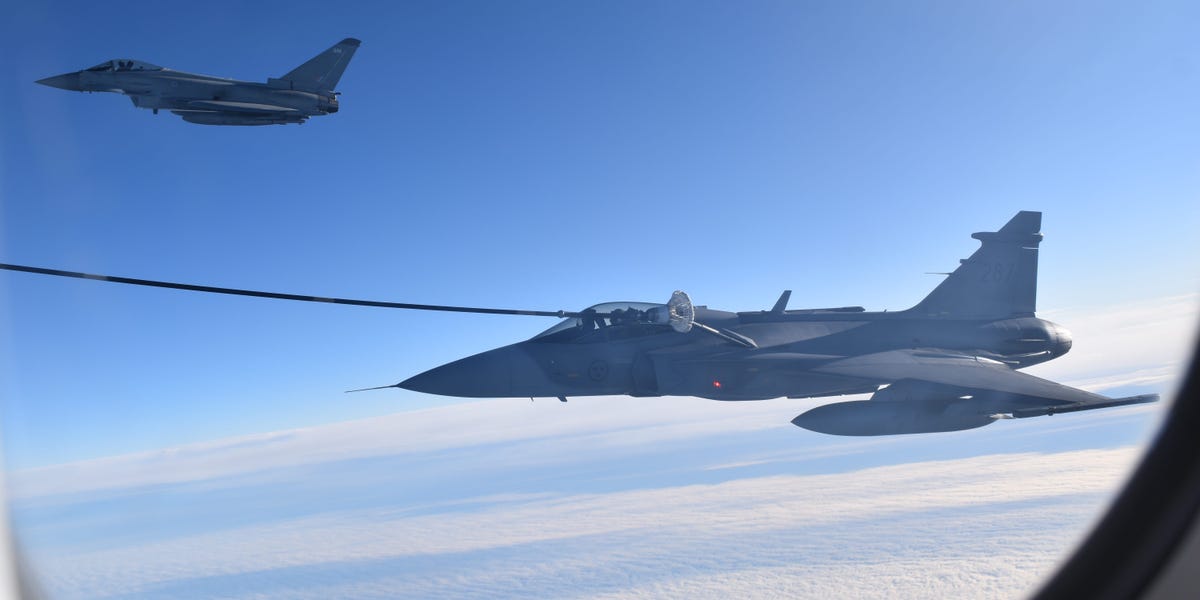
Business Insider visited NATO’s eastern edge this past winter to see how allied forces contribute to Eastern Sentry: from Poland, where soldiers are training on a new counter-drone system, to Lithuania, where Spanish fighters scramble to intercept potential airspace threats, and over the Baltic states, where British tankers refuel jets.
Both Baltic and Eastern Sentry were established as reactive missions, Col. Martin O’Donnell, spokesperson for Supreme Headquarters Allied Powers Europe (SHAPE), which commands NATO’s operations, told Business Insider.
Threats to critical undersea infrastructure and concerns about potential spillover from Russia’s war in Ukraine have been around for years. Arnold argued that the warning lights have been blinking for a long time, saying that the new missions highlight how slowly the alliance has responded to known threats.
Europe’s push to secure the Arctic
Arctic Sentry was launched in response to different threats, as well as a realization that NATO has an opportunity with Russian Arctic forces bogged down in Ukraine.
NATO officials have long been concerned about increased Russian and Chinese activity in the Arctic and have pushed for greater investment in the defense of the High North to prevent Western adversaries from expanding their military and economic influence across the strategic region.
In February, NATO Secretary General Mark Rutte announced the launch of Arctic Sentry, a vigilance mission to increase security in the High North through exercises, patrols, and other activities.
Several weeks later, Business Insider traveled to northern Norway to watch NATO artillery forces during Cold Response 26, a routine military training exercise that prepares Western soldiers for combat in the High North. This year, it is under the new Arctic Sentry initiative.
O’Donnell said that through Arctic Sentry, NATO is trying to be more proactive in countering the Russian and Chinese threats.
Andersen, the Norwegian admiral, said that Arctic Sentry was sparked, in part, by the US push to seize Greenland, which triggered a sense of urgency among NATO allies to better synchronize their existing footprint in the region to deter threats.
He said the Greenland debate was a “wake-up call to other European allies about the importance of a well-coordinated posture in the North.”
US President Donald Trump’s repeated criticisms of NATO and aggressive rhetoric toward allies have raised doubts in Europe about America’s commitment to the alliance, prompting some countries to seek ways to reduce their reliance on Washington for security.
Western officials said that through the new Sentry missions, European countries have been able to showcase their initiative and recent defense investments. Though American forces are involved, European militaries are leading the way, O’Donnell said.
Arnold said the Sentry missions largely reinforce existing plans, with NATO sending forces and capabilities to places it should have strengthened earlier. Taking two years to bolster the eastern borders with counter-drone defenses is too slow, he said.
“We’re getting to the position now where almost the three events that have led to these three Sentry missions have been warnings,” Arnold said. NATO, he added, is attempting to regain the initiative after years of reacting to threats it saw coming.
Read the full article here