





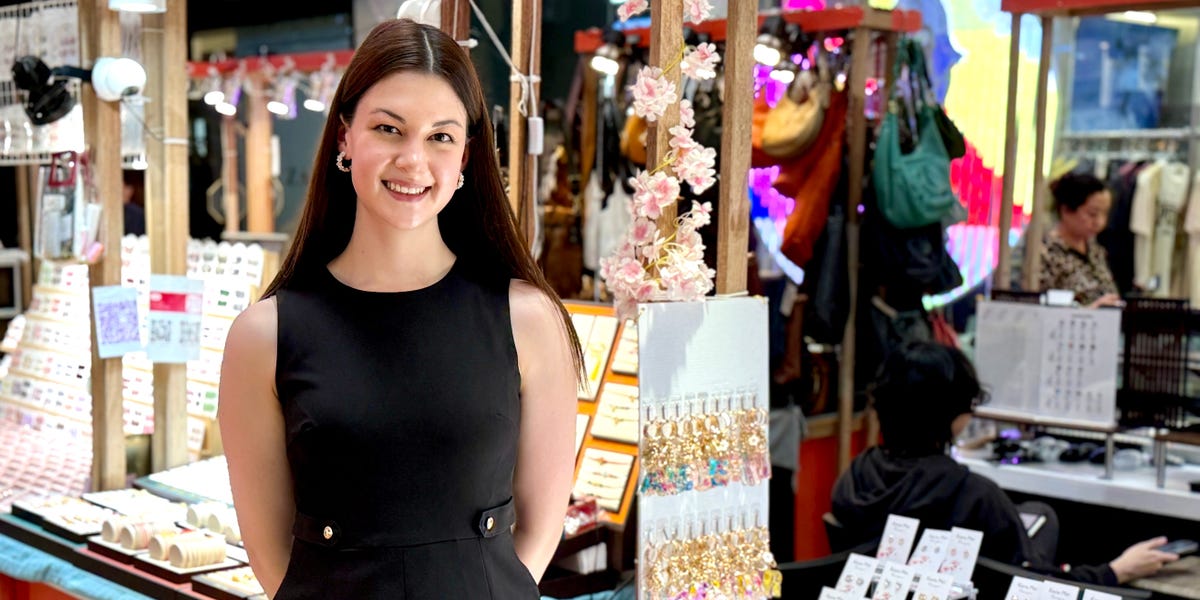
This as-told-to essay is based on a conversation with Kiana Mei, 20, a small-business owner from Australia. It has been edited for length and clarity.
When I turned 15, like all my friends, I wanted to get a job at a café to earn money. But my father pushed me to start my company young, and it’s the reason I’m now financially independent at 20.
I started selling origami butterfly artwork, a skill I picked up from a school trip to Japan and honed during the COVID-19 lockdown.
I started selling them at markets in Melbourne when I was 16. When I made my first sale to a lady who bought three of my artworks for $100, I was shocked. It was the first time I realized I could earn money with something I had made with my own hands.
I added jewelry to the product mix not long after starting my company, Kiana Mei Designs, which sells affordable, customizable jewelry, as well as origami artworks.
Until the end of high school, I balanced school on weekdays and the markets on weekends. I passed my 12th grade with one of the highest grades in my school, which could qualify me for most college courses.
But I decided to go all in on my business for just one year, focusing on growing it instead of going to college. As I was running my business, I thought, “What am I actually going to be studying in university that’s related to business that I’m not already doing now?”
I now have a stall at Queen Victoria Market in Melbourne, open from Tuesday to Sunday. I’ve moved out of my parents’ house, am financially independent, and don’t regret anything.
But there are three things I wish I had known before diving headfirst into my business.
1. The feeling of isolation
The first thing I wish I knew was the isolation I’d feel as a young business owner.
I was still in school when I first started, so I had friends with whom I was quite close at the time, who shared similar academic interests.
But when I finished high school and moved out, and I started doing my own thing, those friends drifted away, and I wasn’t as close with them anymore. We didn’t have much in common.
There are not a lot of young business owners, especially in Melbourne and in Australia, and especially young female entrepreneurs. I’ve attended numerous networking events, but the people around me are a lot older than me, so it’s harder to relate.
2. Learning to prioritize health
I wish that I’d learned early on how to balance work and life, and how to switch off.
Last Christmas, I think I was selling at my stall for 14 days straight without a break. The physical toll it takes is no joke — I think people don’t really realize how taxing it can be on the body to stand all day.
When I get sick and have a cold, I lose my voice completely. Last August, I lost my voice for five days, and that meant five days without work because I need to speak to customers.
But health always comes first, so I try to stay healthy.
I make sure to get a workout in at 5 a.m., then eat a good breakfast before heading to the market. I go to bed around 10 p.m.
3. Knowing my product isn’t for everyone
It’s important to remember that your product isn’t for everyone.
I learned this in the very early days of my business. When customers would walk past my stall without talking to me, I used to feel a sense of rejection.
I would think, “Why didn’t they stop?” and I would overthink everything.
When it comes to retail, you shouldn’t overthink it, because not everyone will like your product, and not everyone will like you. You have to find the people who truly appreciate your products.
Over time, I’ve come to accept that. When I’m at the market, of course, I’ll try to speak to everyone, but if someone doesn’t say hello back to me, or if someone doesn’t want to stop and have a look, then it doesn’t mean anything to me.
It’s just on to the next person.
Read the full article here