


NATO needs cheap drones in the Arctic as the region becomes more contested and critical for security. But the region’s harsh conditions make the technology difficult to operate, warfare experts say.
The Arctic region, a priority for the NATO alliance as Russia and China expand their presence, is vast, difficult to monitor, and impractical for large troop deployments, while traditional combat systems are costly to operate at scale.
The Arctic is becoming “a major security concern, but the territory is so vast and resources are also limited,” Federico Borsari, a drone warfare expert at the Center for European Policy Analysis (CEPA), told Business Insider. That’s why inexpensive drones are key.
Recent conflicts have shown that drones can be valuable tools, replacing and supplementing some traditional weaponry and roles done by humans. But the cold and vastness pose significant challenges that drones must overcome to be effective.
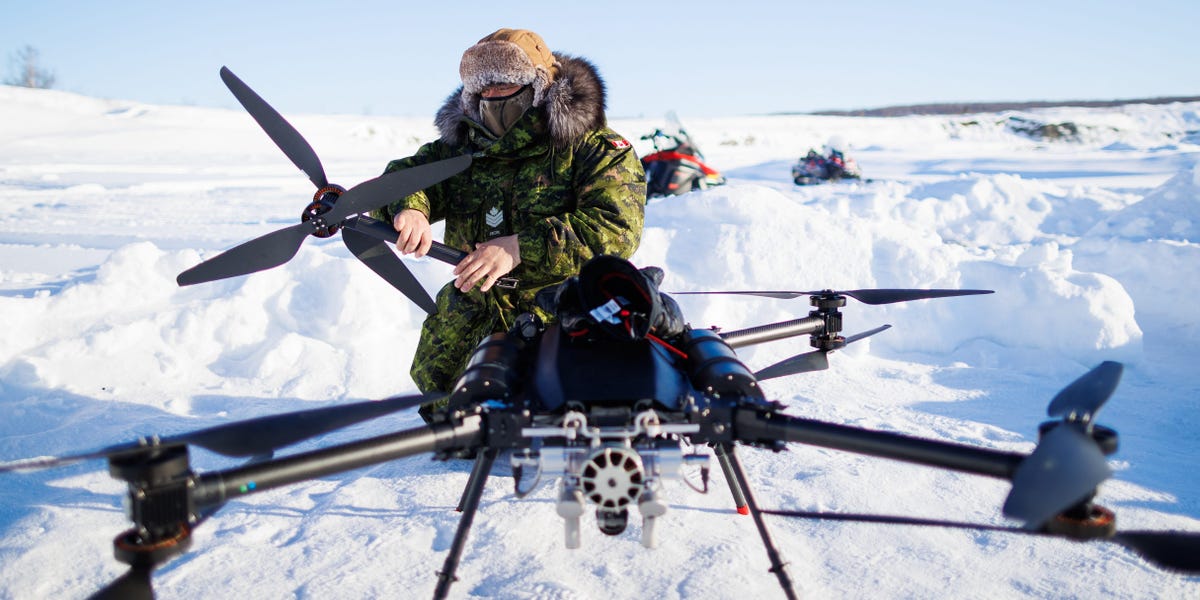
Drones in the Arctic
Drones are desirable because “there is limited infrastructure to support human presence,” Jan Kallberg, a CEPA security expert, told Business Insider.
NATO needs persistent awareness to protect infrastructure, deter adversaries, and prepare for conflict. However, traditional surveillance is “time-consuming” and also “extremely expensive,” Borsari said, requiring crews, fuel, and maintenance across vast distances.
As a result, “there are so many security gaps in terms of situational awareness” despite it being so vital for so many countries for trade, navigation, and critical infrastructure security, Borsari said.
In the Arctic, “drones are extremely helpful because you can really use them to increase your ability to monitor and to survey large swaths of territory without the need to put the human or a human crew at risk,” Borsari said.
Drones would not remove the need for humans or other weaponry in the region, but in many cases, using drones instead of humans is desirable. Kallberg gave the example at a CEPA briefing in January of a recon mission that once required a platoon to travel 20 miles on skis. Now, that mission can be done by a drone.
They can also be used for logistics, like carrying gear in a region where you can’t as easily rely on crewed assets.
Drones can also be used to attack in the region, striking targets or delivering explosives, but that is seen as more of a secondary use and one that would still work alongside traditional weaponry.
It’s not easy for drones there
Sparse infrastructure, difficult communications, and extreme cold all complicate drone operations.
The severe cold can drain batteries and cause equipment to fail. The extremely low temperatures make plastic brittle, increasing the likelihood of drone damage. Furthermore, ice buildup on sensors and propellers can inhibit the aircraft. Winds and fog can also stop drones from working properly.
“What makes it worse is that there are very few, if any, spare parts or repair facilities,” Kallberg said.
The Arctic can experience months of darkness, making visual navigation and detection tricky and limiting opportunities for solar charging.
Ukraine has experienced problems with drones in the cold as it fights Russia’s invasion, with batteries dying, lenses fogging, and components failing.
A Ukrainian drone unit commander previously told Business Insider his unit wraps drone batteries in heated shoe insoles to keep them warm in flight when temperatures are freezing.
Even when functional in the cold, operating drones in the Arctic is a challenge. The barren landscape leaves drones exposed, with little cover to mask them. The lack of background electromagnetic activity also makes their signals easier to detect.
“Even in war-depopulated Eastern Ukraine, there are cell phones, radios, radar, and commercial transmissions,” Kallberg said. It makes drones, commands, and other combat infrastructure much easier to hide.
A CEPA report concluded that “NATO should build Arctic-specific capabilities and infrastructure” and warned that the alliance’s procurement of Arctic-capable drones “remains fragmented, slow, and risk-averse.”
Why the Arctic matters
The Arctic region was long seen as relatively stable and distant, but that is changing.
Melting ice is opening new routes for trade and military activity. US Air Force Gen. Alexus G. Grynkewich, NATO’s supreme allied commander for Europe, this year called the region “one of the world’s most strategically significant and environmentally challenging areas.”
The CEPA report said the Arctic is “undergoing a profound transformation” and said the region “risks transforming into a central arena of global strategic competition driven by three major converging trends: climate change, the return of great-power rivalry, and rapid technological innovation.”
NATO describes the region as the gateway to the North Atlantic, as it hosts key trade, transport, and communication links between North America and Europe. But it also warns that it is “an area of increasing strategic competition” with Russia having boosted its military activity there and China’s interest growing.
NATO is investing in cold-weather equipment, including drones, and conducting testing in the region.
In February, the alliance launched Arctic Sentry, a new mission to coordinate existing lines of effort and boost its presence there, thereby strengthening its overall security posture.
But the US and its allies remain short of many weapons and tools that they need for the Arctic, not just drones. Borsari described NATO’s new steps in the region as promising, but not enough.
Read the full article here