




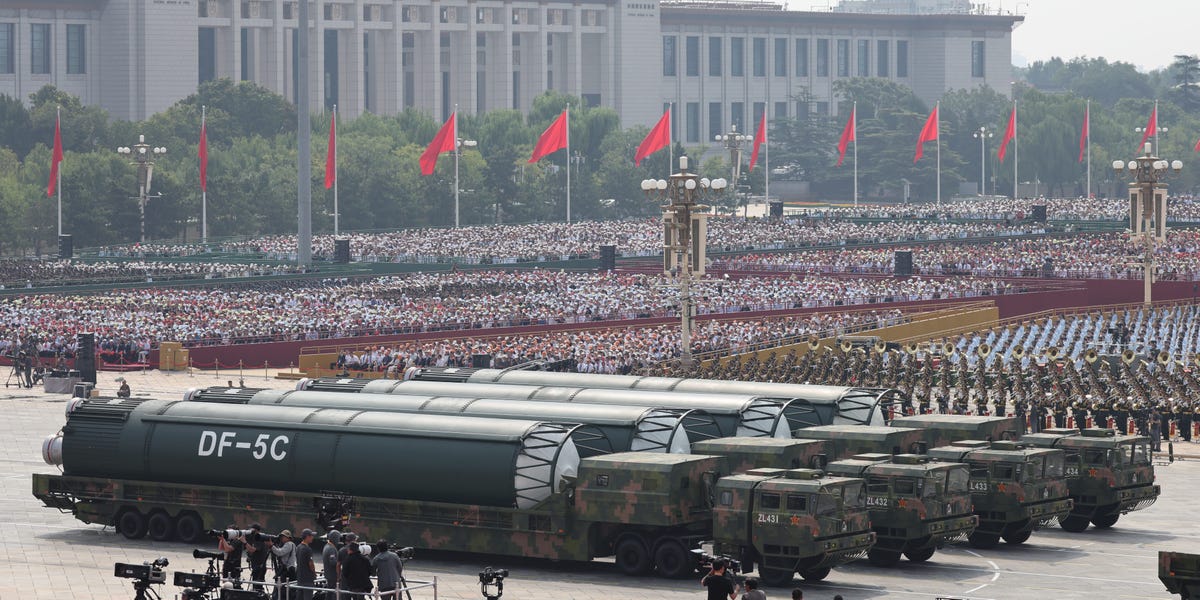
China appears to have fielded a new intercontinental ballistic missile, the DF-27, which can range the continental US and, unlike other ICBMs, serve a mix of missions, including targeting ships, a new Pentagon report says.
The Department of Defense’s annual report on the Chinese military, the latest of which came out last week, is the first public assessment that the missile is operational. The missile is said to have a land-attack and anti-ship role.
The latter role is unusual for an intercontinental-range ballistic missile, as is its conventional strike role documented in the new Pentagon report. ICBMs are primarily for nuclear strike.
The latest report offers little on the new missile beyond a map showing China’s “fielded conventional strike.” The DF-27, identified as an ICBM with a range of 5,000 to 8,000 km, shorter than some other systems built for strategic nuclear strike, is a new addition to that map showing Chinese missile ranges.
That range completely covers Hawaii and Alaska, and it also extends into parts of the continental US. The exact reach might vary depending on the launch site, but broadly, the weapon puts naval forces and US military installations across the Pacific at risk in a new way.
A “long-range” DF-27 missile was first mentioned in the 2021 Pentagon report. It said that indications on the range hinted at either an intercontinental- or intermediate-range missile. That uncertainty persisted until the 2025 report identified it as an ICBM.
The 2024 Pentagon report notably offered the most detail, stating that the DF-27 had been “deployed” to the Rocket Force. It added that this weapon likely has an option for an HGV, a hypersonic glide vehicle, “as well as conventional land-attack, conventional antiship, and nuclear capabilities.” The 2025 report, however, did not put the weapon under “fielded nuclear capabilities.”
According to the Missile Defense Advocacy Alliance, the DF-27 carries potentially significant strategic implications.
In an early assessment of the Chinese missile published two years ago, the group cited a leaked intelligence briefing indicating the missile was tested in February 2023 and warned that it could give China another means to hold targets at risk beyond the second island chain, with a high likelihood of being able to penetrate US ballistic-missile defenses and the potential to serve as a “carrier killer.”
China has not publicly commented on the DF-27, though local media have at times approached the topic indirectly.
Fielding the new DF-27 makes China the first to have an operational, conventionally armed ICBM. The US and Russia have not fielded similar capabilities; however, both have been pursuing new intermediate-range capabilities since the collapse of the Intermediate-Range Nuclear Forces Treaty, which the US walked away from in 2019 after accusing Russia of non-compliance.
The DF-27 is the latest example of China’s efforts to develop and field varied, flexible strike options for a potential conflict. The missile branch of its military, called the People’s Liberation Army’s Rocket Force, has grown exponentially, and Chinese military doctrine emphasizes the need for it to possess the ability to quickly, precisely, and, in some cases, preemptively strike targets.
With the new DF-27 ICBM, “China became the first to field an analogous capability: a conventional ICBM—with an ASBM variant—that can conduct rapid, long-range precision strikes out to intercontinental distances, including against its ‘strong enemy’s’ homeland and its naval forces at sea,” Andrew Erickson, a professor at the US Naval War College’s China Maritime Studies Inistitute, wrote last week.
Since the Pentagon’s annual reports cover only developments from the previous year, the newest one doesn’t include other notable missile developments in China from this year. An important development in September was Beijing’s reveal of the DF-61 and DF-31BJ, both ICBMs, at a military parade.
It’s unclear whether those missiles are operational, but even if they’re still in development, the implications of the presentation in the Chinese capital are that these missiles will eventually be additions to China’s already sizable land-based ICBM arsenal.
Read the full article here