





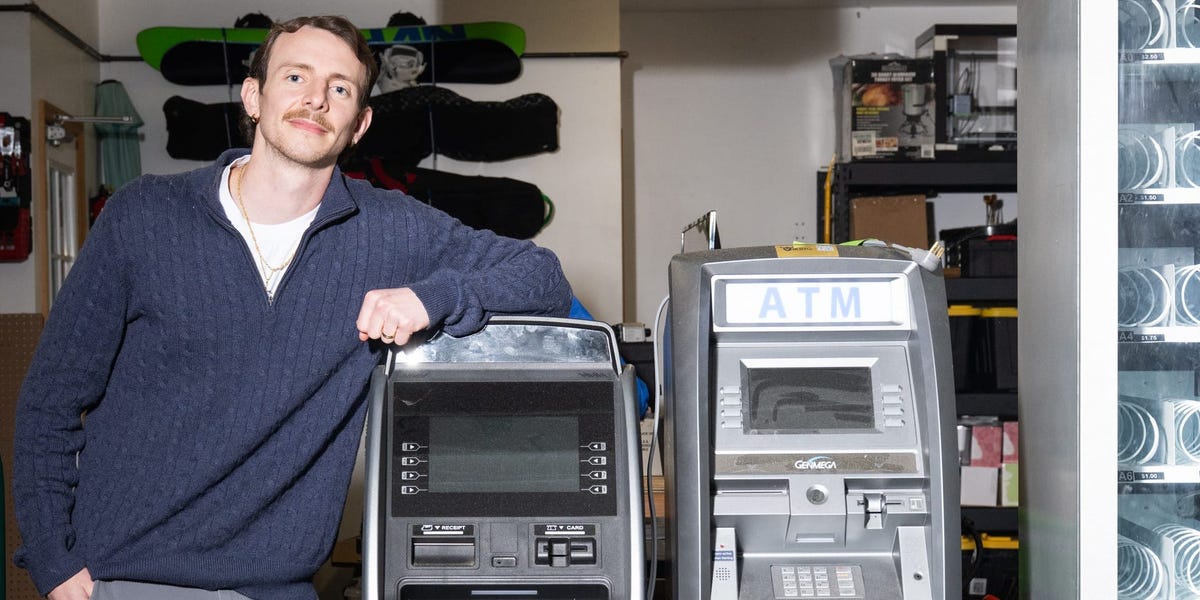
William Butterton doesn’t believe in passive income, but he thinks he’s found the closest thing: ATMs.
“It’s essentially your employer that you don’t have to pay,” the full-time electrical engineer, who has experimented with a variety of side hustles, told Business Insider. “It’s doing the transaction for you.”
Butterton, who lives across the water from Seattle in the small town of Silverdale, has always wanted to start and run businesses.
“I had invention journals when I was a little kid,” he said. Though he had no shortage of entrepreneurial ideas in his 20s, he never acted on any of them. “I was always really comfortable, and I was fine being comfortable.”
That changed after he had his first kid. He started seriously looking for ways to bring in extra income without investing a ton of time, which led him to his first side hustle: buying and placing ATMs.
Every time Kathleen publishes a story, you’ll get an alert straight to your inbox!
Stay connected to Kathleen and get more of their work as it publishes.
“The more I looked into it, the more I was like, ‘OK, there’s really no risk in trying this, outside that original financial obligation of $2,500 to buy the ATM,'” he said. “My buddy and I decided, ‘Hey, let’s give it a shot.'”
Getting an ATM business up and running with $5,000
Anyone can go online and buy an ATM. When Butterton and his friend decided to test the side hustle in 2022, machines cost around $3,000 each, after tax.
Beyond the purchase price, they needed about $1,000 in cash to stock the machine and another $1,000 in reserves, for a total upfront cost of about $5,000 per machine. They ordered two, which were delivered to Butterton’s garage.
“From that point, the hardest, most difficult part in starting was actually finding a business bank account that would allow you to run an ATM company,” he said, explaining that many large banks are wary of ATM businesses because some operators have been linked to fraud and money laundering.
Once they found a small local bank willing to process ATM transactions, the next step was pounding the pavement to find a location.
“How successful you are is completely dependent on how well you can sell yourself,” he said.
First and foremost, he targets cash-only businesses. Next, he’ll look for businesses that prefer or incentivize cash payments or tipping, such as barbershops, nail salons, and convenience stores.
In Washington state, “the marijuana dispensaries are like the pinnacle of where you’d want your ATM located in terms of profit, but they’re extremely hard to get into,” said Butterton, who’s not yet in any dispensaries, but does have ATMs in nail salons.
Scaling to eight machines that profit $1,500 a month
Butterton and his partner intentionally called their company “Viking Vendors” so they wouldn’t pigeonhole the business into ATMs. His broader business philosophy is to “paint a broad brush stroke, and dial it in after,” he said.
They decided to expand into vending machines next. It meant learning about reseller permits and different tax structures, “so it becomes a little bit more complicated, but that’s allowed us to get into other businesses in the area that don’t need an ATM, and still be fairly passive,” he said.
They quickly learned that loading food and drinks is not nearly as passive as loading cash, though.
“If I were advising people that might be interested in either, I personally would stick with ATMs,” he said. “The product that you load in an ATM is a lot easier to carry around with you than pallets full of drinks and stuff.”
Since launching Viking Vendors in 2022, they’ve grown to eight machines total — five ATMs and three vending machines — that profit $1,500 a month on average. BI viewed terminal activity summaries to confirm their earnings.
Most of that profit comes from ATM surcharge fees, which go directly into the business’s bank account. Setting the fee takes some trial and error and is location-dependent. The goal is to find a price that maximizes the number of transactions, he said: “If I have it set at $2 and I get 100 transactions, and then I set it at $3 and I still get 100, well, then, that $2 is probably too cheap.”
Butterton said he typically charges around $3 per transaction and hasn’t had to share ATM profits with any of the locations where he’s placed machines.
Vending machines work differently. They typically make money by marking up products — for example, buying an item for $1 and selling it for $2. If a business lets them store inventory on-site, Butterton said, they’ll usually share about 10% of profits in return. That arrangement saves him from having to haul drinks and snacks in his car.
While the business has relatively low operating costs, theft and vandalism can eat into profit margins. Butterton said he’s had one ATM stolen and struggled to find affordable insurance early on. The coverage he initially found cost about $2,500 a year, which was hard to justify when he had only two machines. He said he has since found cheaper insurance, and because the cost is about the same whether he covers two machines or 10, it becomes easier to absorb as the business scales.
He and his partner plan to add more machines, but cautiously: The bigger the fleet gets, the more time they have to spend loading and maintaining it.
Each week, they spend about an hour apiece on the business, which allows Butterton to keep his full-time job and pursue other side hustles, including selling collectibles on the live-streaming platform Whatnot and growing his all-natural, food-safe wood finishes company, One-Eyed Willy’s.
More machines could bring in more money, Butterton said, but he’s more interested in finding the point where the extra income is still worth the time. For now, the business helps cover expenses like a car payment and daycare while leaving him time with his family.
“Of course, I want a huge business. I would love to make $100,000 a month doing ATMs,” he said. “But I also realize that my kids are only going to be 0 to 5 once, and the business is going to be there in five years.”
Read the full article here